Decoding Wine: What’s in a Label?

November
3
2025

We browse the shelves of wine shops all the time, not only to shop for dinner but also to scope out the deals. More than ever, we see a massive proliferation of wine labels with creative imagery, lingo, and descriptors. New brands and labels seem to be appearing every week. All this choice is amazing: or is it completely overwhelming depending on how you approach the situation.

One clear way to become more comfortable when confronted by endless shelves of unfamiliar wine labels is to figure out how to decipher the information given. Reading wine labels can be daunting, but not so difficult when you finish this article.

One thing to note is that regulations, both domestic and international, dictate what info must, can, and cannot appear on the label. Master that with the help of this article, you’ll be well on your way to finding that special wine bottle with much more ease.

Wine labels have a lot of information on them. Some of it is critical to understanding what is in the bottle, and some of it is just blowing smoke. Here’s a quick guide to help you know what matters, how to spot a bargain, and what to ignore.
How To Read A Wine Label

There are 2 main styles of wine labels commonly found in shops. A wine identified by its brand name or a wine designated by its appellation, region, or sub-region. A wine that is labeled by its brand will indicate what grapes it’s made of on the front label (whether it be chardonnay or ‘red blend’).

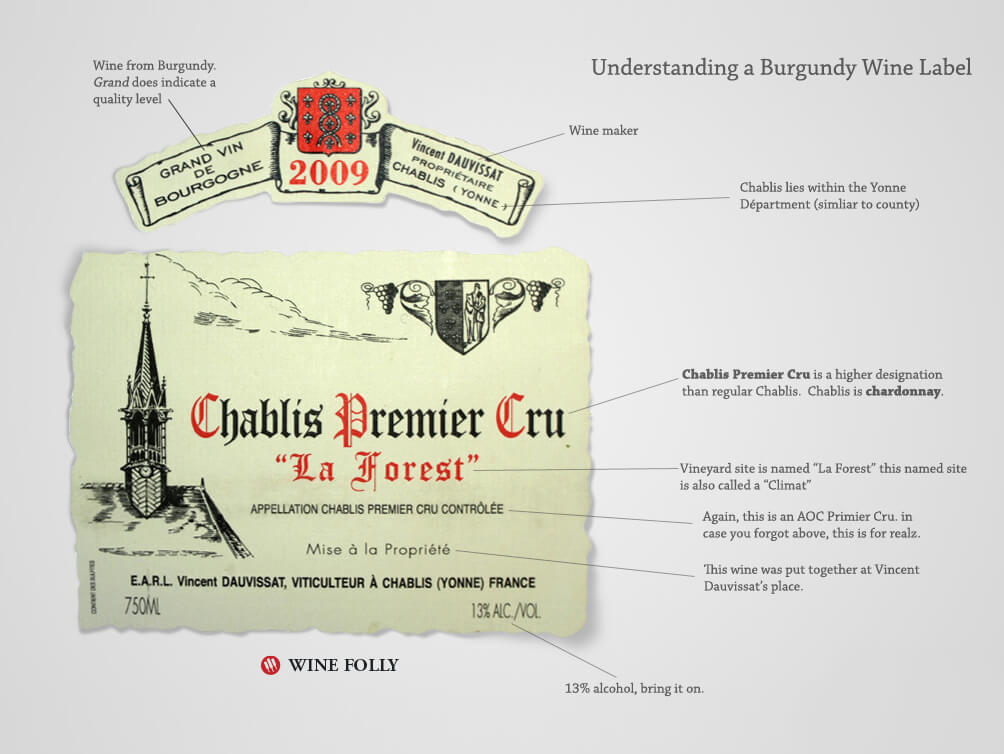
A wine that is identified by its appellation relies on the appellation’s quality level rules and regulations by country to indicate what’s in the bottle. A perfect example of an appellation wine is Chablis. Nowhere on a Chablis label is a mention of chardonnay as the grape, nor that Chablis is typically an unoaked chardonnay.

Understanding a wine label may not always tell you how the wine tastes but it can help you get a better picture of exactly what you are buying.  


5 Basic Parts To A Wine Label


Producer or Name The producer’s name is either obvious or in small text at the top or the bottom of the label (such as many French wine label examples). This is who made the wine. It’s important to note that some American wine labels that only have a Wine Name (such as Apothic Red) are branded wines from larger wine companies. Apothic Red is a branded wine by E&J Gallo–the producer.

Region The region indicates from where the grapes were sourced to produce the wine. A wine from a larger (read: more vague) region is typically a value wine whereas a wine from a specific vineyard site often indicates a higher quality regional designation (i.e. “California” vs. “Santa Rita Hills” AVA). If a wine is from a specific vineyard site, that site will be indicated in quotations (i.e. “Les Suchots”) or located right below the region designation (ie Vosne Romanee Les Suchots). Generally, as you narrow the source to a specific site, the quality level becomes more refined and the price increases.

Variety or Appellation The variety refers to what grape or grapes are used in making the wine, i.e. Merlot or GSM Blend (Grenache, Syrah, and Mourvedre). Many blends will not reveal the constituent grapes nor the percentage that each makes of the whole. If there is no varietal given, look for the Appellation, which can give you clues to what varietals were used based on the rules governing that region. There are 15 nations with officially regulated appellations, though the strictness of the rules and what matters varies wildly among them.

Vintage or Non-Vintage (NV) The year that the grapes were harvested is the vintage. The vintage tells a lot about a wine if you are familiar with vintage variations. As a general rule, multi-vintage wines or “NV” wines are lower value wines, because they have the ease of pulling wine from multiple vintages to control the flavor, except in the case of Champagne.

Alcohol by Volume (ABV) The alcohol level actually says a lot about a wine. Many European wine regions only allow their highest quality wines to have 13.5% ABV and above. In America, ABVs can be quite high (up to 17% on some dry wines) and the alcohol level is an indication of how rich/big the wine may taste. Many higher alcohol wines are made from riper grapes and tend to have more fruit forward flavors. Again, this is a generalization and there are exceptions to the rule.


Some Wines are Labeled by Grape Variety

When you see a wine labeled with “grape” words like Cabernet Sauvignon or Gruner Veltliner, then it’s labeled by grape variety. There are thousands of different wine varieties and it’s possible to label a wine with more than one grape.

Wine labeled by variety doesn’t guarantee that the wine is 100% of the listed variety. Each country has their own set of minimum requirements to label wine by variety (Surprisingly, the United States has the lowest!):

75% USA (except for Oregon which requires 90%), 80% Argentina, 85% Italy, France, Germany, Austria, Portugal, New Zealand, South Africa, Australia, United Kingdom.


Some Wines are Labeled by Region

Wines like Bordeaux, Chablis, Chianti, Sancerre, and Rioja are labeled by region. This style of labeling is used mostly in Old World wine countries like France, Italy, Spain and Portugal. Regional labeling likely came from a time when many different varieties grew together in the same vineyards and were blended together into wine.

Each wine region dictates what grapes can be used in the regional wine. So, in order to know what’s inside one of these regionally labeled wines, you’ll want to do a little research. For example, Chablis in France grows Chardonnay, and Chianti in Italy specializes in Sangiovese.


Some Wines are Labeled by Name

The last common style of wine labeling includes wines using a made-up or fantasy name. More often than not, named wines are unique blends invented by the wine producer. You’ll also find named wines common in regions that do not allow the use of certain grapes in their regional wine (but still grow them). For example, Tuscan wines made with French-origin grapes including Merlot, Syrah, and Cabernet are not allowed to be labeled as an Italian regional wine. (This is how the first Super Tuscan wines came to be!)

Common Label Confusions and How to Avoid Mistakes

Anyone new to reading wine labels can get confused pretty quickly. Here is a breakdown of key things to look for.

“Reserve” Means Different Things – It’s not a legal term everywhere, so don’t assume it guarantees top quality. Research might reveal that it’s just marketing fluff in some regions.

Non-Vintage (NV) Wines – Often sparkling wines or blends without a specific year. That can be confusing but generally indicates consistent style rather than ignoring quality.

Multi-Grape Blends – Sometimes the label lists a single variety, but the wine could be a blend. If you aren’t sure, ask a trusted vendor or check online reviews to get the full story.

Old-World vs New-World Labeling – European wines tend to emphasize region over grape, while New World wines (like from the US or Australia) highlight grape variety first. That’s helpful to know when trying unfamiliar wines.

Pronunciation Woes – Don’t let tough to pronounce names scare you. It happens to everyone. Ask in store or look it up.

Getting around these common issues makes wine shopping less intimidating and more fun.

Picking the Perfect Wine for Your Next Dinner Party

Here is a potential real-life scenario. You’ve got a planned Friday night with friends, and you want to bring a bottle that everyone will love without breaking the bank or appearing clueless. How do you choose?

Start by thinking about the food. If you’re serving a classic Italian pasta with tomato sauce, a medium-bodied red like Sangiovese is your go-to. Check the label for the region—Chianti, for instance, shines here. Look for a recent vintage but avoid very young wines that might be too tannic.

Maybe you want a white to kick off the evening. Something crisp, light, and crowd-pleasing like Sauvignon Blanc from New Zealand? Search for “Marlborough” on the label, which is famous for this style of wine. A vintage within the last two years keeps that fresh, zesty vibe going all night.

Last, but not least, don’t ignore the fun part. Personal touches like a unique bottle design, label, or interesting backstory can spark conversation and set the tone. For adding a playful or classy edge, personalized wine labels can be a hit. Btw, I’m guilty of buying a bottle based on the label and overall appearance of the bottle. I know it sounds superficial of me but have fun with it. If you know me, I am more attracted to substance and personality.

Watch the video below from my friends over at Wine Folly. If you would like to learn more about German, French, or Italian wine labels, which can be super hard to read, please reach out. Also, if you desire a deeper dive into what to look for in a bottle, please don’t hesitate to ask.

Cheers,

Michael Nagy

(Cover Photo courtesy of Lucia Capretti & Tasting Table)

Who is Michael? What is The Michael Pour?

October
27
2025

Here is a little bit about me, my business, The Michael Pour, and how I got here.

My name is Michael and I’m excited to be here talking ‘wine’. I’ve always had a love for writing, so this is a great way to share my creative side, versatility, and knowledge about wine.

I am originally from Harrisburg, Pennsylvania in the south-central part of the state. In 2019, I moved to Geneva, New York, northern tip of Seneca Lake, in the heart of the Finger Lakes, to further my wine career and embrace a new beginning.

I have a B.S. in Psychology from the University of Pittsburgh and worked in the counseling and social work industry for the early part of my career. In 2000, I became a stay-at-home dad and needed to find a part-time job where I could work nights and weekends for childcare.

One day, I found a classified ad in the local newspaper (that was how you found a job back then) for a bartending school and thought that this would be a fun career. This would work well with my schedule. I quickly learned that I was pretty good at this bartending thing and possessed the people skills to be successful and do it as a career.

My passion for the industry took flight in 2002 when I became a bartender at a full-service, upscale restaurant in the Marriott hotel servicing the airport and capital city. Eventually simple bartending led to a deep dive into wine and food/wine pairings from the excellent menu and wine program.

After many years bartending and doing wine work in the hotel business and making cameos at nightclubs, bars, pubs, and private parties, I decided to take a job as a mixology instructor and wine expert at a nationally recognized bartending school. In addition to teaching/instruction at the school, I provided consultation services to local restaurants.

In 2012, I decided to open up my own business called, Raise Your Spirits, Inc. providing bar consultation, cocktail, spirits, wine, hospitality services and event services to individuals, event and wedding venues, and companies.

During this time, I started blogging and writing about my experiences in the industry, which led to writing and publishing a bar and cocktail book titled “The Cocktail Revolution: Journey of a Liquid Chef” during the pandemic in 2020.

After living in PA most of my life and running my business, Raise Your Spirits, Inc. for eight years, I decided to take a leap of faith, start anew, leave family and friends, and move to upstate NY and the beautiful Finger Lakes region to focus on my wine career.

I completed my wine education through the Wine & Spirit Education Trust School based in London, England. I earned my Level 3 Advanced Certification in Wine. I continued my wine education by earning my wine specialist certificate in French wine.

My knowledge, experience, and expertise with Finger Lakes and New York State wine is very strong. I strive to learn new things in the world of wine and stay on top of the trends.

From 2019 to 2023, I worked as a wine educator, tasting room manager, wine club director, marketing and public relations director for numerous wineries on Keuka, Seneca, Cayuga Lakes.

For the latter part of my time in the Finger Lakes, I served as the GM and ran the exquisite wine and cocktail program at Portico Restaurant, an upscale, Italian steakhouse in Del Lago Resort & Casino.

During this time, I rebranded my old business to “The Michael Pour” where I focused primarily on wine, providing consultation services, private wine tasting events, wine lists, virtual and in-person wine classes, networking, and storytelling through writing and blogging about wine.

In August of 2024, my life and career took me to Syracuse, NY with the intent of continuing my business operations and work with private venues, bars, restaurants, and organizations doing wine tasting events, wine classes, wine dinners, marketing, and consultation.

My hope is to bring the excitement of Finger Lakes and New York State wine to the Central NY region and Syracuse area. As a member of Women for Winesense, Syracuse Chapter, potential board member and former member of Finger Lakes and Rochester chapters, I am excited about the opportunity to grow my business and support a wonderful organization offering fun, wine programs in the area. All are welcome (men, women, non-binary) to join our group.

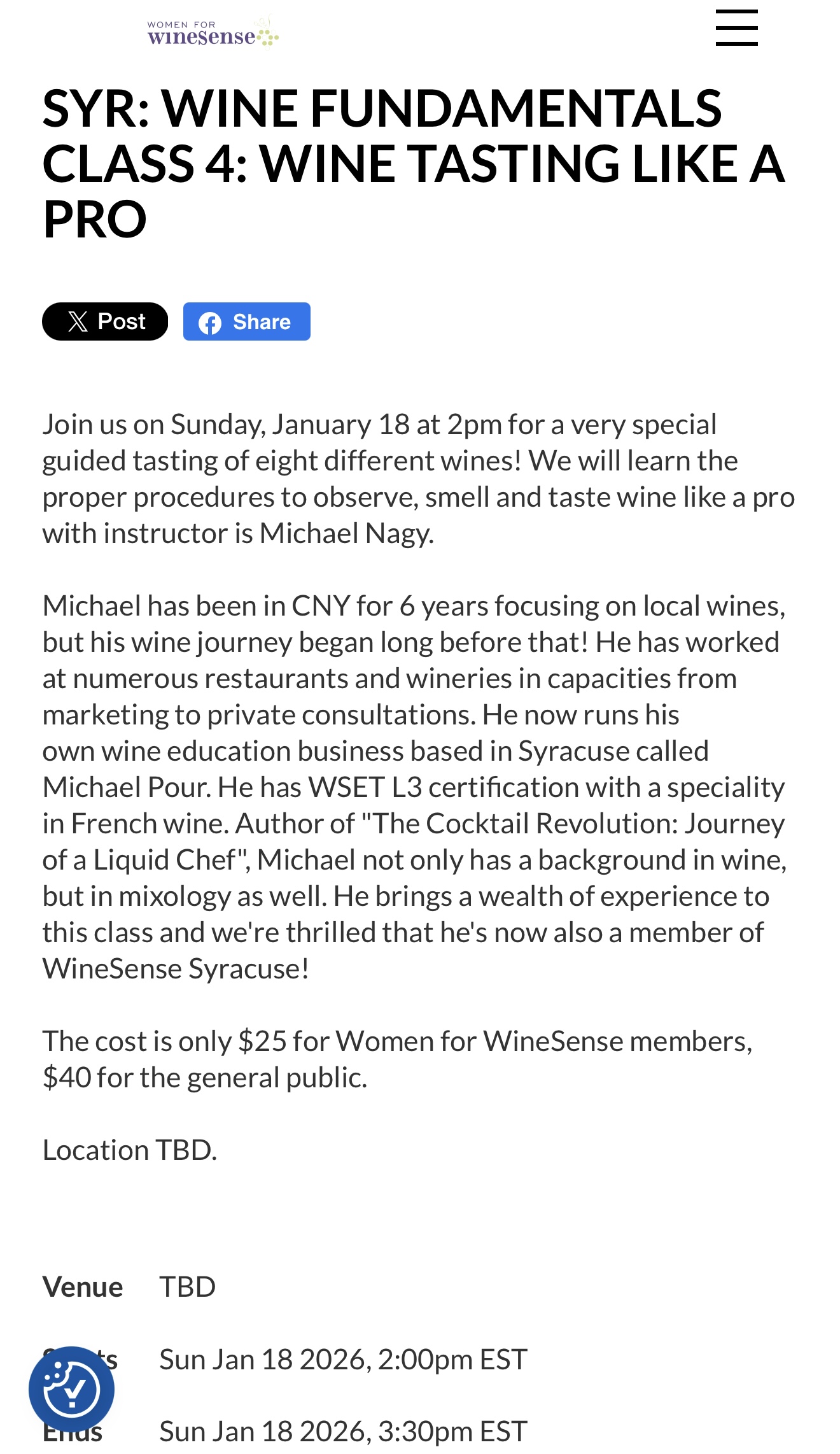
Visit the website for more info (Syracuse Chapter page). I will be teaching a fun wine tasting class in January through the Syracuse Chapter (see image) so I hope to see you there.

Would you like to experience great wine for your formal or casual dinner party? Are you looking to plan a special event with your friends or colleagues and want it to be epic? Are you an establishment who wants to elevate your wine program?

Whether you are an experienced wine drinker, host parties or events, a business, or someone just getting started in the industry, you’ve come to the right place.

My dream is to stock people’s wine cellars with exquisite and collectible wine and serve as their wine consultant and personal sommelier.

I also moonlight as a freelance beauty consultant, MUA, and skincare consultant after spending time with Mary Kay, Sephora and Ulta Beauty over the years. I currently work as a brand ambassador for Urban Decay Cosmetics and IT Cosmetics.

My interests outside of wine are kitties (I have 2 cute furries), traveling and seeing the world, learning about different cultures, shopping, pizza, old-world Pinot Noir, purple and green colors, fast cars, Pittsburgh sports, all things beauty, reading, writing, book hoarding (not a fan of kindling), good old-fashioned rock-n-roll music, and musical theater.

I am partially fluent in French and love French culture, which goes hand in hand with French wine.

Thanks for stopping by! Let’s get acquainted and go on this fun journey together. Please let me know if I can be service to you or your place of business. Being new to the area, I would love to meet youMichael

Wine of the Week: Little Known Red from Austria

Zweigelt Wine of the Week
January
6
2025

I had the pleasure of sipping this wine over the holiday season with in-laws. It was a nice change of pace from what I typically drink even though it reminds me of a nice Pinot and Lemberger all in one bottle.

Did you know that the country of Austria produces some really good wine? Can they grow red grapes and produce red wine in their cold climate? Although Austria is better known for its white wine, it does grow and produce some surprisingly good reds that are unique to the red wine world.

Austria as a whole is still white wine country, but of the 30% or so red vineyards, the most widely planted grape is Zweigelt by far. Zweigelt (pronounced TSVY-galt) and other reds are nothing like the new world reds in California, Chile, Argentina, and Australia nor old world reds in France, Italy, and Spain. Austria’s reds are very similar in style to Germany reds.

Austria is a landlocked country in Central Europe, bordered by eight countries – Germany to the northwest, Czech Republic to the north, Slovakia to the northeast, Hungary to the east, Slovenia to the south, Italy to the southwest, and Switzerland to the west

Zweigelt is a relatively young grape variety, having been created in 1922. The grape is a cross between the St. Laurent and Blaufränkisch grape varieties, which are native to Austria. It is a versatile grape that is grown throughout Austria’s wine regions. It is well-suited to Austria’s cool climate, as it ripens early and is resistant to cold temperatures. This allows the grape to be grown in cooler, higher-altitude vineyards, which are not suitable for many other grape varieties. 

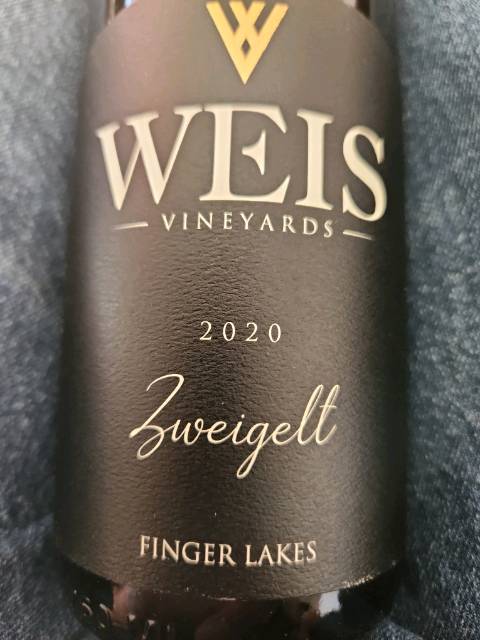
Weis Vineyards Zweigelt

When you go to buy red wine and looking for something new and different, consider Zweigelt, and in particular the one I’m featuring in this post as well as one from Weis Vineyards, German winery off Keuka Lake located in the beautiful Finger Lakes, NY. Weis also produces a Dry Rose from the Zweigelt grape. Check them out! They are one of the best wineries in New York State.

The grape generally produces medium-bodied wines with moderate acidity and tannins. The wine has a vibrant ruby color and aromas of dark berries, such as blackberry and black cherry, as well as spicy notes of pepper and cinnamon. On the palate, it has a smooth, velvety texture with flavors of dark fruit, warm spice, vanilla, and sometimes even a hint of chocolate.

Zweigelt is a very food-friendly wine that pairs well with a variety of dishes. It is especially good with meat dishes, like roasted pork, beef, lamb, and duck, as well as with hearty vegetable dishes and warm stews in the winter.

Zweigelt is also an excellent choice for those looking for a more affordable alternative to some of the more well-known red wine varieties. While it is not as well-known as some other grape varieties, Zweigelt is gaining popularity among wine lovers, both in Austria and abroad. 

Austrian wine, in general, has gained a reputation for high quality and unique flavors, and Zweigelt is no exception. In recent years, Austrian winemakers have increasingly focused on producing high-quality Zweigelt wines, and the grape has been gaining recognition and awards at international wine competitions. 

In all, Zweigelt is a versatile, affordable, and high-quality red wine grape variety that is gaining popularity among wine lovers worldwide. With its unique flavor profile and food-friendly nature, it is definitely worth trying for anyone looking for something new and exciting in the world of wine. 

.

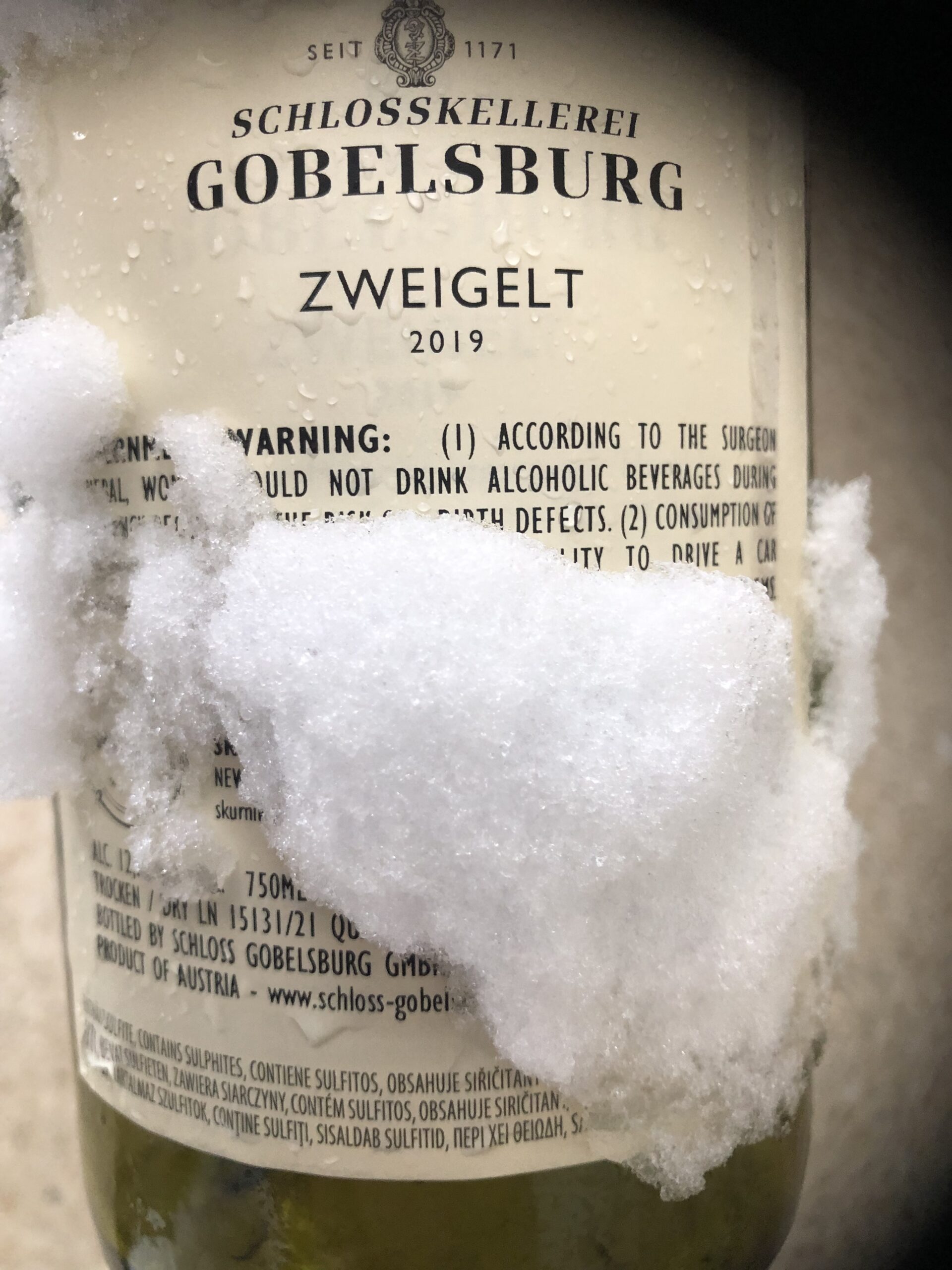
Schlosskellerei Gobelsburg Zweigelt, Niederosterreich, 2019 (cover photo)

Btw, German and Austria wines have very long wine names and sometimes hard to pronounce. This bottle of Zweigelt brings forth a nuttiness of almonds and dark cherries and berries on the nose along with a spicy and peppery aroma. It has a light-medium body and well balanced with enough acidity, although not crispy.

This Zweigelt offers a toasty character from some oak, but still fresh and youthful on the palate. It is a juicy, but elegant, energetic red wine with a nice aroma that lasts through the palate and medium finish. 12.5% alcohol.

It has reached its age of maturity in 2025 (not an age-worthy wine by tradition so drink now when it’s good). It is most likely at its peak for drinking.

Try this wine or search for more at your fine wine shop. Most local wine shops only carry 1-2 Zweigelts in inventory so call beforehand or just order this one online. You will not be disappointed! My rating is 8 out of 10 (very good). I won’t feature a wine unless it receives a score of 7 (good) and above. My personal rating system is out of 10; different from most professional ratings….Cheers, M

Seasonal Spotlight: 5 Must-Try Wines for the Fall

Chenin Blanc wines
November
4
2024

November and autumn season brings a different vibe to the world of wine, and certain wines belong on the table. The weather gets colder, the day gets shorter, and that chill in the air shouts comfort. Certainly, comfort can be felt through sweaters, pumpkin spice lattes, and comfort food, but what about wine. With campfires, apple picking, and the looming Thanksgiving holiday, there is a call for more complex, savory, and fuller bodied wines. It’s the season of homemade soups, stews, butternut squash, sweet potatoes, poached pears, and apple pies.

While we’re not quite ready for the heavy and tannic Cabernet Sauvignon or Barolo to carry us through winter, we need something more ‘chill’ and transitional to get us through shorter days and set the stage for winter. Some traditional fall favorites that are fantastic include Pinot Noir, Merlot, and Gamay Noir/Beaujolais. Try the Gamay Noir from Sheldrake Point Winery in the Finger Lakes. It is beautifully done!

Beaujolais Nouveau is a wonderful, light, and approachable red wine that is perfect as an introductory wine for non-red wine drinkers. It is made from the Gamay grape and originates from the Beaujolais region of France. It is celebrated worldwide and released every year at the end of November. Beaujolais is one of my favorite wines to sip all year long, especially on Thanksgiving, because it is very food-friendly with turkey dinner. I will discuss it further later this month.

Here are five under the radar lovely fall wines (two whites and three reds) that don’t get enough love in my opinion. They are not as obscure as you might think. If you would like to receive my recommendations, just give me a holler.

1. Chenin Blanc

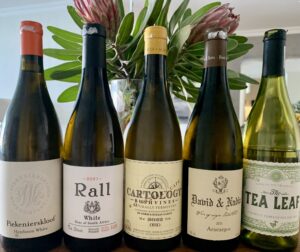
Famous for its apple aromas and flavors, Chenin Blanc is a perfect match for autumn lovers. Just like apples can be used in a variety of sweet and savory dishes, this medium-bodied white wine is extremely versatile, and can be paired with a wide range of main courses. Try a glass of Chenin Blanc with a root vegetable salad, roasted chicken, or rich seafood. Look for it in the Loire Valley of France, South Africa (leading producer of Chenin Blanc worldwide), United States, California and some in Washington State.

2. Sémillon

A medium-bodied white wine from Bordeaux, France, which is often blended with Sauvignon Blanc, giving it a lush, mouth-filling, and zippiness for green and fall veggies. Some are produced in oak and aged in the barrel, which will give it notes of honey, almond, and a smooth texture. The grape has few tannins, medium acidity, medium body and some oily consistency. Depending on its origin, you will discover flavors of lemon, pear, or papaya. Look for it in the regions of Pessac-Léognan, Bordeaux, Napa and Sonoma Valley, California, South Africa, and Columbia Valley, Washington State.

Barbera wine

3. Barbera

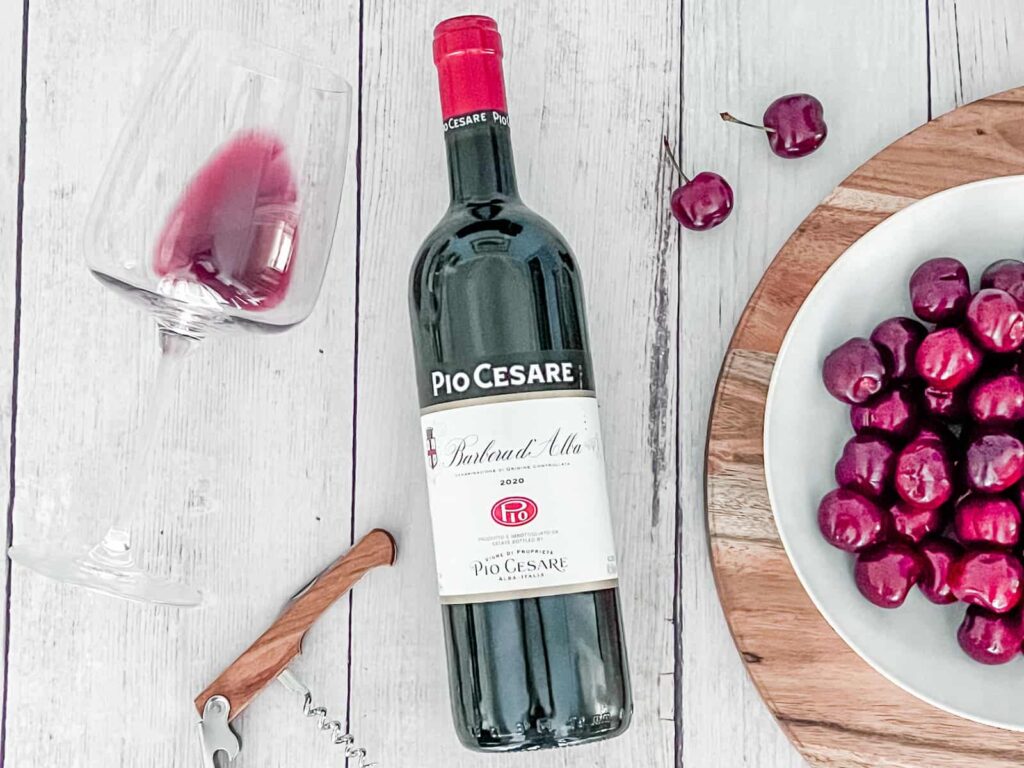
Although it doesn’t quite have the revered status of the Nebbiolo grape, Barbera is Northern Italy’s wine of the people and is never too far from the dinner table in the Piedmont region. In Piedmont, where Barbera is most expressed, Barolo and Barbaresco are the most recognizable names, but they are places as opposed to grape varieties. Both are produced from the Nebbiolo variety. Barbera, on the other hand, is the name of the grape variety itself.

Due to its pigmentation, Barbera can taste both rich and light-bodied, offering the berry and cherry notes in bigger wines, but goes down easily thanks to lively acidity. Oak-heavy styles have an extra touch of chocolate, vanilla and spice. Generally, it is going to be a lighter style of red (more approached) in context of other Italian reds. Look for it in California, US, and Argentina as well.

4. Primitivo/Zinfandel

This wine is jamming. Primitivo and Zinfandel are essentially the same grape. Primitivo in Italy and Zinfandel in the US and the rest of the world. The lighter, low-ABV styles of Primitivo have rose petal, sage, and black pepper flavors, The richer styles add a bit of smoke and jammy. Notes of cinnamon, raisin, chocolate, and tobacco make for an exquisite fall wine. Generally, Primitivo is medium to full-bodied, with medium to high tannins and low to medium acidity. It can carry a high-ABV in Italy compared to Zinfandel due to the warmer climate.

Zinfandel is a bold and fruit-forward wine that’s loved for its jammy fruit, smokiness, and exotic spice notes. It’s also made into a sweet rosé called White Zinfandel. Look for Zinfandel in regions of Lodi, Napa and Sonoma Valley, and Sierra Foothills, California, US, and Primitivo in Puglia, Italy.

Nathan K Cabernet Franc

5. Cabernet Franc

Cab Franc is the parent grape of Merlot, Cabernet Sauvignon, and Carménère. It can be lighter or bolder depending on where it’s grown. If you prefer non-fruit-forward red wine offerings, then Cabernet Franc is your wine. There are more pronounced notes of red and black fruits, like strawberries, raspberries, and plums, in warmer climate versions, but in cooler climates, you will encounter herbaceous, mint, green bell pepper notes, chili pepper, peppercorns, crushed gravel, and earthiness. It is an awesome Thanksgiving wine that pairs with everything on the table because of its savory notes.

It is the signature red grape of the Finger Lakes region of New York, where I call home, and one of my favorite wines to drink no matter the occasion. Look for it in the Loire Valley of France, Colchagua Valley of Chile, Tuscany region of Italy (fruitier style), Sierra Foothills of California, US, and throughout New York State. Try all vintages of Cabernet Franc from Nathan K Wine Cellars, Lamoreaux Landing Wine Cellars, who does an oaked and unoaked version) and Damiani Wine Cellars in the heart of the Finger Lakes.

As mentioned earlier, please reach out if you want my recommendations for the wines listed above. It’s never too early to stock up on wine for the holidays or to enjoy now. Look for Thanksgiving wine pairings and Beaujolais Day post later this month.

Cheers,

Michael

michael@michaelpour.com

(717) 877-2729

Wine Glass

DON’T MISS A DROP

Get notified when new articles are poured

We don’t spam!