Wine Spotlight: A Sparkling Taste of Veneto

May
28
2026

This week’s wine spotlight highlights a great style of sparkling wine from Italy called Prosecco. Have you heard of it? For this discussion, I chose a fantastic Prosecco emanating from its home in the Veneto region.

I recently sampled it when I was tasting some bubbly for a wine list I was constructing for a new wine bar called The Lucky Dog Bistro. It sure was a palate pleaser and I thought it would be a perfect sparkling addition to the menu. Thank you to Sarah from Soilair Selection for the awesome recommendation.

Isotta Manzoni ‘Cuvée Giuliana’ Prosecco (NV) is a crisp, value-driven, small production, sparkling wine from Italy’s Veneto region. Made 100% from the Glera grape, it is light, slightly acidic, and on the ‘fizzier’ side of prosecco making it very refreshing and ideal for mimosas or casual sipping.

The production is the Charmat (tank) method, which preserves fresh, fruity characteristics with a second fermentation. Sourced from vineyards nestled in the hills between Conegliano and Valdobbiadene, and produced by fourth-generation winemakers. The fermentation is 25 days in stainless steel tanks and then aged for 1 month in stainless steel tanks. The result is larger bubbles.

Cuvée in the name is a French wine term derived from cuve (meaning “vat” or “tank”). Depending on the context, it typically indicates a specially selected blend of multiple grape varieties, a winery’s premium or reserve batch, especially in Champagne, or the purest “first-press” juice extracted from grapes.

The Cuvée Giuliana is the standard, widely available Brut-style Prosecco. The Prosecco Rosé version is a delicate, dry rosé expression that features light notes of red berries, strawberries, and cream. This was also added to the wine list.

It is a well-balanced Prosecco with delicate and expressive aromas showing a good blend of crisp green and baked apple, sour lemon and grapefruit with a light, soft, silky and creamy mousse texture on the palate.

As you go back into the glass, some notes of pear and white peach appear on the nose followed by hints of apple and citrus. The Isotta Prosecco has a fair amount of body and mouthfeel with a pleasant lemon and mineral finish.

It’s refreshing acidity and elegant bubbles make it an incredibly versatile pairing option. It goes wonderfully with everything, including fresh seafood, shellfish, prosciutto/cured meats, vegetarian dishes, brunch favorites like eggs benedict or light pastries. Bon appétit!

The Isotta Manzoni Prosecco and Rosé version is now available at The Lucky Dog Bistro in downtown Clinton, NY where you can enjoy it at the beautiful new wine bar with inside and outside seating or in the restaurant. Try it in the special mimosas on the weekend. Hopefully I will see you there! Find them on Instagram @luckydogbistro and here About | The Lucky Dog Bistro.

Ancient Romans drank Prosecco to preserve youth and lengthen life. And based on how long the empire lasted, it may just work. Prosecco is a great alternative to Champagne and generally contains less alcohol. Every year, one bottle of Prosecco is produced for every 2 people in the US. That’s a lot of bubbles! It is currently in the top 25 of Italian Prosecco wines in New York and one of the popular wines distributed with Soilair Selection out of NYC.

A lovely, somewhat less popular, and often less expensive comparison to Champagne, Prosecco is a deliciously dry sparkling wine with crisp acidity, low sugar, with plenty of fruit and character. Associated with high value at low cost, Prosecco is the perfect option in situations where you want or need a easy drinking, everyday sparkling wine.

Traditionally from the Veneto (northeastern Italy), Prosecco refers to the name for a small village and is fermented almost solely from a grape called Glera. Most Prosecco is non-vintage, which means it doesn’t come with a year of production on the label.

This wine is not made in the traditional method of champagne with riddling, disgorging, rebottling, etc…, which, combined with non-vintage production, makes the wine more affordable than champagne minus the labor intensity. Prosecco is often described as a fresher and fruitier option than the French sparkler.

A few fun facts –

Styles of Prosecco – ‘Spumante’ means fully sparkling while ‘frizzante’ means lightly sparkling. It is rare but some Prosecco is a still wine, not sparkling.

“Extra Dry” Prosecco is actually sweeter than “Brut”. “Dry” is the sweetest of the three. This sweetness scale from dry to sweet: Brut – Extra Dry – Dry.

Prosecco isn’t a grape. The grape used to be called Prosecco, but it isn’t anymore. In 2009, Italy officially renamed the grape ‘Glera’ so that Prosecco could be protected as a place name rather than a grape variety. By law, Prosecco must contain at least 85% of the Glera grape.

Cheers & Sante,

Michael, michael@michaelpour.com

Cantina di Rosina: A Majestic Slice of Abruzzo

Carunchio Abruzzo Cantina Rosina
May
20
2026

For this week’s spotlight, The Michael Pour takes you on a journey to Southern Italy along the coast of the Adriatic Sea.

Here you will find one of Italy’s best kept secrets and underrated wine regions, Abruzzo “uh-brut-sow”. Recently, I’ve learned about a new winery emerging in the region. The winery is called “Cantina di Rosina” and their wonderful story, and family history is depicted below.

“Throughout the 18th and 19th centuries, our ancestors produced quality wine in the Southern Abruzzo region of Italy. After WWI, our grandparents emigrated from war-torn Italy to the US in search of a better life for their family. Now, 100 years later, they have returned to my beautiful ancestral village of Carunchio to carry on producing wines that are approachable, elegant, and capture the spirit of this stunning region. Carunchio is a commune and town in the province of Chieti in the Abruzzo region of Italy. 

They’ve assembled a world-class team of viticulturists, oenologists, and winemakers to pay tribute to this beautiful land and all it has to offer. Great wine begins with great respect for the land. Our ongoing mission to share the beauty of Abruzzo with the world…one glass at a time.” – John, my Friend & Proprietor

Cantina di Rosina’s first vintage was 2024. Their Montepulciano d’Abruzzo 2024 is described as being sturdy with solid structure, yet soft tannins with a long finish. It spends some time in concrete creating complexity and texture before going into stainless steel (no oak).

Flavors of dark cherry, leather, and hibiscus are exhibited. It will pair well with any type of game, grilled red meats, cured meats, and ripe cheeses. Serve it at cellar temp or slightly below room temp at 60°- 65°F. Don’t hold onto for very long.

The Cerasuolo d’Abruzzo is a bold rosé with a cherry red color from a gentle kiss of skin contact. With a maceration of only 4 hours on the skins before fermentation, the color is deep and vibrant. It is made 100% from the Montepulciano grape and is essentially a rosé that drinks like a red offering a full spectrum of food pairings.

Not your normal “pink” wine or rosé for that matter. It projects an intense aroma of rose petals and flavors of wild berries and a savory herbaceous quality that lingers. Try it as an aperitif! Drink young.

Enjoy it chilled (50°- 54°F) all summer long by itself or with an array of food options, like seafood dishes, roasted white meats, pizza, cured meats, and semi-matured cheeses. I experienced this awesome wine with homemade bucatini pasta, blush sauce, andouille sausage, shrimp, and fresh herbs over the weekend, and it was a lovely pairing.

The Trebbiano d’Abruzzo DOC 2024 will be released in the next few weeks so you can enjoy all summer-long.

All the wines are 100% certified organic with sustainable farming practices. I have tried the wines, and they are very clean, bright, and complex.

A little bit about the Abruzzo region to better understand the land, microclimate, vineyards, and what goes into the wine that is produced here.

Abruzzo is an Italian region located about a two-hour drive east of Rome. Abruzzo extends from the snow-capped Apennine Mountains to the balmy Adriatic Sea. This magical scenic region offers summits and seacoast, medieval castles and clifftop villages.

It is a major wine region famous for robust Montepulciano d’Abruzzo red wines and crisp Trebbiano d’Abruzzo whites. The region is characterized by mountainous terrain, with most production in the coastal Chieti province, offering high-value, quality wines often with soft tannins and red fruit flavors.

National parks and nature reserves cover much of its rugged interior. It also encompasses hilltop towns, dating to the medieval and Renaissance periods. The regional capital of L’Aquila is a walled city, which was damaged in a 2009 earthquake.

Abruzzo is also known as “the greenest region in Europe” as half of the region’s territory is protected through national parks and nature reserves, more than any other region in Italy. Culturally, Abruzzo is considered a region of Southern Italy; however, geographically it is often considered part of Central Italy.

The focus in Abruzzo is on the Montepulciano grape referred to as Montepulciano d’Abruzzo.  It’s a versatile grape, in the sense that it can satisfy many different palates. Montepulciano is a fruit-forward dry red with a medium to full body, medium to high smooth tannins, and medium to high acidity. Notes of red plum, blackberry, dried herbs and thyme, and baking spices.

It is not be confused with Vino Nobile di Montepulciano, which is a wine made from the Sangiovese grape in the town of Montepulciano from the Tuscany region. 

It can be vinified and aged in stainless steel to give a simple, approachable wine and food-friendly with freshness and expression of the fruit. For low crops, it can be aged in casks or barriques, sometimes new barriques, to create wines that have greater depth, concentration and complexity.

The oaked Montepulcianos coming out of the region are not wines for everyday drinking because they can be very dense, inky, and powerful. These bottlings can be a great option for the winter months. Some can develop gamey aromas with age while others continue to display primary fruit flavors for years.

Montepulciano does typically age well, but it’s not a wine that requires you to age in order to enjoy now and show complexity.

Montepulciano is the most planted grape in the Abruzzo region. It represents 80% of the total DOC wine produced in Abruzzo. The Montepulciano grape has been in Abruzzo since the mid 17th Century. According to DOC rules, Montepulciano d’Abruzzo wines must contain at least 85% Montepulciano, with Sangiovese often used for the rest. Bottles labeled “Riserva” must be aged at least two years.  

Another reiteration of Montepulciano is Cerasuolo “chair-ah-swolo” which translates to “cherry red” and refers to an Italian wine style. It is Abruzzo’s best kept secret! Cerasuolo d’Abruzzo is a Rosé made from the Montepulciano grape. It is made from the free run juice and/or juice with very little skin contact and the color can vary from light pink to dark red. A rosé wine that is usually made by giving the juice a maceration of eight to 18 hours on the skins before fermentation. 

The result is almost like a light red rather than a rosé. A wine with body and succulence not typically rosés. It’s very popular in the region, but you will not see many exported. However, that is starting to change though in recent years.

Even in a good pizzeria in the regional capital of Pescara, you don’t necessarily want to drink a rich red all the time. Cerasuolo, with its vinosity and weight, is actually best drunk lightly chilled. Most producers agree that you shouldn’t consider Cerasuolo a way to use up your least interesting grapes or put in a blend. It should be made from grapes of high quality and treated seriously even its rosé.

The signature white from Abruzzo is Trebbiano d’Abruzzo is a light white Italian wine known for its dark gold or amber-colored berries, high acidity and neutral flavor profile that produces stone fruit and apple aromas with hits of lemon. Though production remains small when compared to Montepulciano, it is starting to make an appearance on the world stage.

Being a very large and dispersed region of vineyards, Abruzzo is divided into many sub-regions, and there are also DOCs that are permitted to use non-Italian varieties such as Chardonnay or Merlot. Only someone who is an expert of Abruzzo terroir would be able to identify the many sub-zones for Montepulciano in the glass. Look for different styes of Sangiovese coming out of the region. 

In many older regional vineyards, the vines are trained on tendone (pergolas) designed to shade the grape clusters and make harvest easier. Newer plantings are arranged in rows. 

Tons of sunshine and generous rainfall provide happy growing conditions for wine grapes in Abruzzo. The higher elevations and combination of mountain and maritime breezes bring down summer temperatures, setting up conditions for warm days and chillier nights. This is ideal for maintaining acid balance in the ripeness. Most vineyards flow along the warm and dry coast in the nearby hills. 

I am excited to be representing Cantina di Rosina winery as an ambassador in the Upstate and Central New York region so let me know if you want to schedule a tasting or place an order. Orders can be placed directly from their website or from my link in bio.

You can contact me, Michael Nagy, at 717.877.2729 or michael@cantinarosina.it The wines are truly remarkable by themselves but will also elevate your food experience and company.

If you have an Italian restaurant, steakhouse, pizzeria, or wine shop, these wines will be a perfect complement to your food menu and Italian wine section.

Allow me to share the beauty and story of Abruzzo and Cantina di Rosina (CdR) with you. Find the website at www.cantinarosina.it and on Instagram @cantinarosina. Follow them and me @themichaelpour 🙂

Cheers & Saluti,

Michael

Your Favorite Summer White Wine? The Winner Is…

May
7
2026

A poll was conducted on Instagram and the results are based on 25 responses.

The four choices given in the poll were – Sauvignon Blanc 40%, Riesling 36%, Chenin Blanc 20%, Pinot Gris/Grigio 4%. An additional 10 different white wines were submitted in comments.

The winner is “Sauvignon Blanc”. Because Sauv Blanc was the winner, I will feature it later in this story. Sauvignon Blanc is produced all over the world so I will explain the differences from region to region and fun facts about this noble grape.

There were several people who wrote in their choice of these four, as well as other white wines, that they like to drink in the summer from the additional list provided or others that they like.

These write-in responses are not included in the above percentages but listed below with country/region. Every wine mentioned on the post were included. Pinot Grigio and Sauvignon Blanc, which were choices on the poll, were written in and not reflected in percentages.

Submitted whites – Verdejo (Spain), Gruner Veltliner (Austria & US), Chablis (France), Riesling (FLX), Alsace Riesling (France), Albarino (Spain & Portugal), Txakoli (Spain), Vinho Verde (Portugal), Chardonnay (all over), Sancerre (Sauvignon Blanc from Loire Valley France).

I included other great summer white wines not voted for or listed as people’s favorite below. They can be super refreshing, crisp, and brilliant this warm, summer season regardless of your plans.

If you would like to try something different for your summer wine drinking and expand your summer palate, seek them out and give them a whirl.

A few quotes. Thank you to all those who participated. It really made this a fun story! –

“Albarino and Txakoli are two other summer favorites” ~ thesipseries

“I like a crisp Chablis. Cold sauvy b (from any region) is also a plus. But please do not put jalapenos in it” ~ mollyb

“I also love Vihno Verde in the summer”~ sonyab

“I also love a good Chardonnay! Don’t really care where its from”~ rebekkah

“I like a crisp Sancerre in the summer. Also, Albarino is another favorite”~ shannonp

Most of these varietals are specific to their native land and difficult to find here in the states. They range from aromatic, light, medium, and full-bodied and from dry to off-dry to medium-dry. Listed by country of origin and region, if significant, body, and sweetness level.

Italy

Trebbiano Toscano – light to full bodied and dry to off dry

Vermentino – light bodied and dry

Greci di Tufo – medium to full bodied and dry

Verdicchio – light bodied and dry

Fiano – light bodied and dry

Garganega/Soave – light bodied and dry

Greece

Assyrtiko – light bodied and dry

Argentina

Torrontes – aromatic and dry to off dry

France

Semillon (White Bordeaux, Australia, US) – light to full bodied and dry

Viognier (Rhone, US, Australia, similar to Chardonnay) – aromatic and dry

Marsanne (Rhone) – light to full bodied and off-dry

Roussanne (Rhone) – light to full bodied and dry

Aligoté (White Bordeaux) – light bodied and dry

Picpoul (mostly Loire Valley) – light bodied and dry

France & Spain

Grenache Blanc/Garnacha Blanc – dry and light to full bodied.

France, Italy, Greece & others

Muscat Blanc – aromatic and dry to medium dry in France

All over Europe and some pockets in US

Pinot Blanc – dry and light bodied

US, France & all over the world

Gewurztraminer – aromatic and dry to off dry

If you would like to learn more about any of these delicious white wines, please reach out. Have you experienced a glass or bottle of Sauvignon Blanc from different parts of the world?

Sauvignon Blanc

Here is a take on your favorite Sauvy Blanc grape. If you’ve been sipping from the same bottle of SB over the years, you know, that one called “Kim Crawford” from New Zealand, then you may not realize that it is produced all over the world, not just in NZ.

During my recent time in Columbia Valley, Washington, I had the pleasure of experiencing some really good ones. It is the same grape no matter where it is planted, but because it is grown in a different place, it becomes a completely different wine.

Here are four expressions of Sauv Blanc from four elite wine regions. Some may know of them, while others may be surprised. SB used to be the ‘it” girl, but is gradually being replaced by the trendy Chenin Blanc for that title. My wine colleague, Molly B, loves it very cold!

Sancerre

Sauvignon Blanc is called Sancerre in the classic Loire Valley of France. The most popular regional wine of the Loire is Sancerre. It is largely produced in the Touraine region. Sancerre is lean and mineral driven with notes of citrus, in particular lime and grapefruit, gooseberry, possibly some green apple, herbal flavors (same compounds found in green peppers), and slate/flint. My friend, Shannon P. is a big fan!

There can be some smokiness, which is unusual for whites, considering the lack of oak influence. Stylistically, the Sauvignon Blanc from Damiani Wine Cellars called “Little Lotus Flower” in the Finger Lakes Region of NY is similar to a Sancerre.

Marlborough, South Island, New Zealand

Sauvignon Blanc is New Zealand’s most important grape and Marlborough is the top producing region. The wines here offer more green tropical fruit notes, like kiwi, passion fruit, and pear, that contain a touch of residual sugar to help balance out the high acidity in the grapes.

The wines can be explosively aromatic with the aroma source of freshly cut grass. It can be zesty. That’s a signature aroma that can help you determine that you’re drinking a SB from NZ.

White Bordeaux, France

Here Sauvignon Blanc is more structured and textured. Notes of citrus, in this case, more lemon and grapefruit, and honey and light wax/lanolin texture. It is often blended with Semillon from Bordeaux, a fuller bodied wine with a rounder and creamier texture and notes of apple. Semillon can age better than Sauvy B so this blend can give you more years to drink. Some of the best sweet, dessert wine called Sauternes is made from Semillon.

Napa Valley, California, USA

Sauvignon Blanc in the warm Napa and Sonoma Valleys can offer a riper, richer, and more generous version of the grape. Notes of tropical fruit, like melon, and stone fruit, like white peach dominate while still displaying a little citrus and herbaceous notes. Some Sauvignon Blancs in Napa are aged in oak creating more texture, complexity, and vanilla notes. Even in this warmer climate, the wines have ample acid backbone, and the good winemakers make it shine with the fruit.

What does all Sauvignon Blanc have in common?

All Sauvignon Blanc wines share a foundational profile characterized by high acidity, a dry, light-to-medium body, and vibrant, herbaceous, and fruit-forward aromas, typically spanning citrus (grapefruit, lime, lemon) to tropical notes (kiwi, melon, passion fruit).

It is consistently a cool-climate or high-acidity grape used to produce crisp, refreshing, and usually unoaked white wines. Most are produced to be drunk young, crisp, and fresh. Alcohol content generally ranges from 11.5% to 14% ABV.

While climate affects whether the wine tastes greener/herb-forward (cooler, e.g., Loire Valley) or tropical fruits (warmer, e.g., California), its fundamental “green,” high-acid structure remains consistent.

Sauvy Blanc is very food-friendly wine because of the high acidity and lighter body. Pair it with herb or citrus-driven sauces, green veggies and summer salads, salty cheeses, herb-crusted chicken (Napa especially), white fish, oysters and mussels (Sancerre especially), scallops, and all kinds of Asian cuisine (New Zealand, especially).

What other white wines are similar to Sauvignon Blanc in terms of its style and profile?

Fume Blanc (Loire), Gruner Veltliner, Vermentino, Chenin Blanc (Loire), and Verdejo.

Here are my recommendations for each regional Sauvignon Blanc. The exception is that I chose a Semillon was Wash State, US instead of one from Bordeaux.

Domaine Henri Bourgeois ES-56 Sancerre 2022

Chateau Brondelle 2021 Graves Sauvignon Blanc Semillon

St. Supery 2020 Napa Valley Sauvignon Blanc

Dog Point Vineyard 2025 Marlborough Sauvignon Blanc

Cheers & Sante,

Michael XOXO

50 Shades of Rosé: A Summer Spotlight

FLX Rose
May
1
2026

Pink Wine. Rosado. Rosato. Blush. Vin Gris. Summer Water. Saignée. What’s in a name or label?!

Rosé all day? Yes way, rosé. Stop and smell the rosé, rosé every day. Rosé isn’t going anywhere. 

It’s May 1st and Rosé Season is upon us.

Although this pretty pink elixir has become the go-to summertime drink for social media influencers, it’s actually one of the oldest types of wines ever made. Surprising to many, this nuanced wine holds significant historical and cultural traditions in some of Europe’s great appellations. Being nuanced doesn’t mean it is too complex and intimidating to learn the basics.

Its worldwide growth and appeal over the last decade are very much the result of celebrity endorsements. There’s not much that Cameron Diaz, Angelina Jolie, and Post Malone have in common, but all of them have put their name to rosé brands and now aisles are adorned with the faces and autographs of singers, actors, TV chefs and, of course, Snoop Dogg. Much can be attributed to the rise of the rosé mansion and mass production as well.

The rosé lifestyle isn’t a great representation of the actual wine. Rosé isn’t a varietal of wine—it’s just a color. “Rosé” doesn’t really describe what’s in the glass. It could be the most refreshing, lively, delicious glass of pink wine you’ve ever tasted…or not. Rosé can be light or dark pink, mineral or fruity, lush and floral or crisp and acidic. Maybe we should look at the world through rosé-colored glasses because some rosés are bad doesn’t mean they all are.

If you’re interested in learning the differences among the world’s rosé, from the effect picking and production techniques have on style, color and taste, to a review of classic European regions, follow along below. Next time you reach for a bottle, you’ll know the difference between Tavel, Provence, Rosado, or Rosato.

Rosé wine actually dates back to the Romans. Some of the first French-produced wines were rosés. Provençal rosé, that crisp, easy-drinking, light pink style that you chug ceremoniously on the first warm day of the year has been commonplace since the early 19th century. Believe it or not, this pinkish drink pre-dates even Lisa Vanderpump 😉

Production Methods

Though it’s commonly believed that rosé is made by blending white with red, most bottles are made through skin contact (like a red wine) known as “saignee.” Blending red wine into white is only common in Champagne — not in quality still wine. Further, another misconception leftover from America’s white Zinfandel days is that rosé is off-dry or even sweet. In fact, most quality-driven rosés are a variation on bone dry.

Skin Contact

Have you ever heard a producer use the phrase “intentional rosé?” The concept entails growing and harvesting grapes for the express purpose of making rosé wine. This means picking early to preserve freshness and bright fruit flavors, followed by a limited maceration. In other words, winemaking follows the same technique as for red wine: crushing grapes and allowing the juice time on the skins.

But for rosé, that time is far less, from a few hours to two days. The shorter the period, the lighter the color – think pale salmon versus dragon fruit pink. After maceration, the wine is drawn off and fermented to full dryness.

Direct press is a variation on this, though is more akin to white winemaking. Rather than allow any contact between skins and juice, the grapes are pressed and the juice is drawn off the skins. But because the grapes are black, the juice will take on a hint of color and flavor. This method yields a delicate rosé, one that’s faint in color, while favoring citrus flavors over red fruits.

Saignée

French for “bleeding,” saignée is often a byproduct, (though not always – see Navarra) of red winemaking rather than utilized as an intentional rosé winemaking method. Grapes are not picked expressly for rosé but rather for the primary red wine. This technique is common in Paso Robles, for example, where winemakers seek to produce concentrated, bold and flavorful reds.

Bleeding some wine off early in the maceration process, concentrates the remaining juice; and the lighter juice that’s bled off gets vinified separately for rosé. Though it’s a perfectly acceptable method, wines can be an afterthought.

Rosé generally demands freshness, and grapes picked for concentrated reds are usually the opposite: ripe with higher alcohol. Of course, it’s a matter of taste – saignée is great for those who prefer a richer, fruitier style of rosé.

Blending

Except maybe late night at a party, fine wine producers don’t blend red and white wine together. At least, French appellations do not allow it, except for one: Champagne. For rosé Champagne, producers may add still Pinot Noir or Pinot Meunier for hue and flavor. Outside of Europe, a few New World producers might blend white and red but it’s not the norm for quality wine production.

Provence Vineyards

Regions To Know

FRANCE

Provence, France

If you’ve sipped a glass of rosé, you’ve probably tasted one from Provence. The OG of pink wine, denizens of the south of France view rosé as a way a of life, not just a beverage. Stylistically, Provençal rosé is distinct, too.

Typically, wines are made intentionally, picked for citrus and tart red fruit flavors, with limited skin contact for lighter hues and delicacy of flavor. It’s not a big, brash, fruity wine; rather, they are meant as crisp, versatile food wines to be enjoyed with vegetables, seafood and even meat.

The classic grapes are Grenache, Cinsualt, and Mourvèdre. Bandol has a large presence in the U.S. for its high quality, pricier versions made from Mourvèdre. Wines are savory, mineral-driven and structured, rather than simple and fruit-forward. Bandol is a rosé that can age.

Tavel, Rhône Valley

Though Provence is better-known in the U.S. market, Tavel is the only French appellation specializing in dry rosé. Talk about intentional winemaking. The primary grape used in Tavel is Grenache. Other grapes allowed include: Cinsault, Bourboulenc, Clairette (pink and white), Mourvèdre, Picpoul (black, white, grey), and Syrah.

While white wine cannot be blended with red, white grapes and their press juice can be added pre-fermentation. Due to longer skin contact, the wines achieve greater color and depth of red fruit flavor. This lends more tannin, structure, and age-worthiness from top producers.

In Chinon, Touraine, Anjou, and Loire Valley, France, Cabernet Franc is the grape of choice where the bests rosés weave delicate vegetal notes and juicy red fruit flavors from the CF.

SPAIN

Spaniards have been drinking rosé for ages; only in recent years have those bottles made their way stateside. Often, producers made simple, quaffable wines. But as exports have increased, so has quality. Instead of rosé, bottles will say Rosado. Grenache and Tempranillo are the main varieties used for making various styles, though often in a deeper hue than their French counterparts.

Navarra

Navarra rosé helped make the region famous. Producers turn out both poolside sippers and more complex, food appropriate expressions. Grapes used include Tempranillo, Cabernet Sauvignon, and Merlot, though rosado from old-vine Grenache is considered the highest expression for the region. Saignée method is typical, but in the case of Navarra, wines are of good quality, not just a fun summer wine.

Rioja

Unusual in the world of rosé, or rosado, is the application of aging classifications to this style of wine. Most producers of rosé tout new vintages for their youthfulness and freshness, using stainless steel vessels in that stylistic pursuit. That, or they need to move product for cash flow.

But in the case of Rioja, rosado follows the classic aging rules in oak barrels: joven (no aging requirement), crianza (aged for 12 months including 6 months in barrel); and reserva (2 years including 6 months in barrel). Grenache and Tempranillo are the primary grapes.

Txakoli

Spain’s northern Basque country is home to unusual, indigenous varieties used to produce dry, effervescent Txakoli. Though rosé is a recent phenomenon, it’s becoming easier to find in the U.S. Made in a pale shade of pink, wines are mineral and tart, and largely based on red grape Hondarrabi Beltza.

ITALY

Known as Rosato in Italy, rosé is made up and down the boot, with styles and flavors dependent on the local climate and traditional varieties available. You’ll find more delicate versions produced in the northeast around Veneto, Friuli-Venezia Giulia and Trentino-Alto Adige. Logical, given the cooler climate.

That includes Chiaretto from Lombardy and Veneto. “Chiaro” means light or pale, evoking the dry style of the wine based on the Corvina grape. Ramato, from Friuli, is based on extended maceration with pink grape Pinot Grigio. Central Italians, of course, produce rosato. One better known example: cherry-pink Cerasuolo of Abruzzo made from the Montepulciano grape.

In the south, rosatos are fuller-bodied and fuller-flavored like the sun and the food. Puglia, Sicily and Calabria turn out lots of examples with native grapes like Negroamaro (Puglia) and Nero d’Avola (Sicily).

Rosé is a type of wine made from red wine grapes, produced in a similar manner to red wine, but with reduced time fermenting with grape skins. This reduced skin contact gives rosé a pink hue and lighter flavor than that of red wine. Rosé is produced around the world, as it can be made from any red wine grape cultivated in any wine-growing region.

UNITED STATES

Finger Lakes/New York

Finger Lakes rosé is a vibrant, cool-climate wine known for high acidity, mineral-driven finishes, and bright fruit flavors like raspberry, cherry, and cranberry. Early harvesting is essential for these wines to retain acidity and because of shorter growing season.

The rosés are known to be fresh, aromatic, possess an array of delicate colors (50 shades of Rosé), and perfect for summer sipping. The maceration time can vary from a few hours to 24 hours depending on grape ripeness, color, or your desired style.

The flavor profile is fresh red fruit (raspberry, strawberry), tart cherry, rhubarb, and hints of dried herbs. The style ranges from bone-dry to slightly off-dry, mineral-heavy, and steely. They are usually made from Pinot Noir, Cabernet Franc, Blaufrankisch, but also includes hybrid blends.

They are starting to see more experimentation with the varietals used for the wine, such as Zweigelt, Merlot, Cabernet Sauvignon, and Gamay Noir.

For my Finger Lakes friends, I am including my personal rosé wine recommendations. This summer, look for a fun, interactive, and educational rosé class in the local Syracuse, NY and Central NY area. Drink those 2023 vintages right now and the 2024 very soon. Don’t sleep on rosés from NYS in general. North Fork of Long Island and Hudson Valley produce some beautiful rosés.

Being a fairly low production wine (~200 cases), you will most likely not find a 2024 at the winery or marketplace. You should see most of the 2025 vintage of the Finger Lakes Rosé already released or soon to be released.

FLX Rosé Tasting by The Michael Pour. Book yours!

Weis Vineyards 2024 Dry Rosé. Also produces a Zweigelt Rosé.

Glenora Wine Cellars 2024 Dry Rosé

Ryan William Vineyard 2024 Estate Rosé

Damiani Wine Cellars 2024 Bouquet (2025 vintage will be released in the next few days). They offer a Dry Rosé as well. Visit them and order at Finger Lakes Winery – Damiani Wine Cellars. Let me know if you would like a taste of these wonderful rosés and the rest of their portfolio. I will come to you.

Bright Leaf Vineyard 2023 Estate Dry Rosé

Chateau LaFayette Reneau 2024 Estate Rosé

Fox Run Vineyards 2024 Dry Rosé

Sheldrake Point Winery 2024 Dry Rosé

Airy Acres Vineyard 2023 Dry Rosé of Saperavi and Blend

Six Eighty Cellars Dry Rosé of Gamay and Pinot Noir

Some of my other favorite rosé styles around the world –

Grenache or Garnacha Rosé (fruity) from France or Spain

Tasting – usually a brilliant ruby red hue with notes of ripe strawberry, orange, hibiscus and sometimes with a hint of allspice. Moderately high acidity, but since most have quite a bit of color and body.

Think a summer evening with gyros and tzatziki on the plate, which I just had this week.

Provence Rosé (fruity) from France

Tasting – Rosé from Provence is the little black dress of pink wines. Fresh, crisp, and dry style is a superb match for almost any dish, Try a juicy burger makes a perfect partner.

Grenache, Cinsault, Syrah, and Mourvèdre are all used and give these rosés nice aromas of strawberry, fresh-cut watermelon, and rose petal, finishing with a distinctive, salty, and minerality on the palate.

Pinot Noir Rosé (hard to produce, fruity, but can be floral and mineral/earthy as well) from all over the world. Some of the best in New York State.

Tasting – The fruit is considered sensitive and temperamental, but when at its best, it can make for a very sexy glass of wine. In Pinot Noir delivers bright acidity and soft, subtle aromas of crabapple, watermelon, raspberries, strawberries, and wet stone. The grape can produce mineral, but-elegant wines that are cool, crisp, and dry. Try with fresh goat cheese, salads, or fresh fruit on the beach.

Other Guidelines

Rosé should always be chilled and served at approximately 50 to 60 degrees Fahrenheit. Place rosé directly into the refrigerator after purchasing it, and chill for at least several hours before serving (30 minutes in the freezer will work in a pinch). I discourage you to add ice cubes to rosé or any wine, for that matter, since ice cubes will dilute and change the flavor of the wine.

It’s better cold to enhance the aromas, flavors and acidity, but not too cold. Too cold stifles the aromas, while too warm can over emphasize the alcohol and dull the flavor.

Most rosé is best to drink when young (1-2 years). So, 2024 and 2025 vintages are ideal right now. Anything older would taste flat and flavorless.

Since rosé wine, as rosé is produced specifically for its fresh and fruity taste, it is not recommended to age. An exception is in the Bandol region of Provence, which uses the Mourvèdre grape and is known for its age-ability. Rosé wines made from Mourvèdre are high quality and can age for up to 10 years in some cases.

Food Pairing

What isn’t a great pairing with Dry Rosé?! Rosé is such a broad category of wine with light, subtle options from southern France, Italy and Spain to bolder options like those from California, Central France, or South America (and so many in between from virtually every wine producing region on the globe).

Pairings really depend on which grape(s) the rosé is comprised of. In general, rosé can be thought of as an “in between” option for a red and a white wine in style. It often has the red fruit aromas of a red wine, with the lighter body and crisp acidity of a white wine. Paired with fresh fruit is magical!

Seafood

The light, often mineral-driven nuances of dry rosé wines, especially those from Southern France or Italy, harmonize beautifully with the delicacy of seafood. Be it a buttery lobster, grilled shrimp, or a light fish dish like cod or sole, the crisp acidity of dry rosé complements the sea’s salty sweetness without overwhelming its flavor.

Chicken & Meat

On the other side of the spectrum, the fruity undertones of rosés from regions like California or Central France make them an excellent match for poultry and lighter meat dishes. A roasted chicken or turkey, grilled pork chops, or even a medium-rare steak can benefit from the medium-bodied, berry-infused charm of a robust dry rosé.

Vegetarian

Vegetarian cuisine finds a delightful partner in dry rosé. The light body and dynamic flavor profile of dry rosé balance the natural flavors of vegetables, grains, and legumes. A Mediterranean-style salad, a hearty quinoa bowl, or a vegetable stir-fry would pair splendidly with a glass of refreshing dry rosé.

Cheese & Charcuterie

The spectrum of dry rosé wine can handle a broad array of cheeses and charcuterie. From creamy brie and tangy goat cheese to salty prosciutto and spicy sausages, dry rosé provides a counterpoint that enhances these bold flavors, making it an ideal choice for a charcuterie board.

Desserts & Sweets

Dessert pairings depend largely on the rosé’s residual sweetness. A drier rosé could pair nicely with a light lemon tart or a bowl of fresh berries, enhancing the dessert’s fruity notes without overwhelming its sweetness. Remember, the art of food and wine pairing lies in balance, and dry rosé is a versatile animal that can harmonize with a broad palette of flavors.

Cheers & Sante,

Michael

michael@michaelpour.com

Wine Spotlight: Getting to Know Beaujolais Wine

November
20
2025

“Happy Beaujolais Nouveau Day 2025”

Beaujolais Nouveau is a light, fruity red wine from the Beaujolais region of France made from the Gamay grape. It is released on the third Thursday of November every year. It is known for its easy-drinking and juicy quality with notes of banana and strawberry, served slightly chilled, and has become a celebration of young wine worldwide.  Its popularity is largely due to marketing efforts in the mid-20th century that promoted a race to get the first bottles to Paris.  

The Gamay grape is also grown in parts of New York State and the Finger Lakes region due to the cool climate and longitude and latitude proximity. Try the Gamay Noir from Sheldrake Point Winery on the west side of Cayuga Lake. You will not find too many Gamay in the marketplace. I did recently indulge in one at Noble Cellar in downtown Syracuse NY. If you do find one in a local shop, expect to only pay around $20–$25.

Beaujolais is the name of a little area in France just south of the Burgundy region. It is one of the few wine regions of France that has a more casual approach. Historically, Beaujolais has been considered a part of Burgundy, but today it stands alone producing high quality, signature wines. The more serious cru designations of Beaujolais drink very much like a red Burgundy (Pinot Noir). Beaujolais is arguably one of the lightest reds you will encounter.

Where is Beaujolais?

  • Bordered by Burgundy to the North – the Saône River (which leads to Côtes du Rhône) to the East – the “Gastronomic Capital of France”, Lyon, to the South – and the Monts de Beaujolais (the hills of the Massif Central) on the West.
  • Beaujolais is just 34 miles long and 7-9 miles wide.
  • Divided into two sections by the Nizerand River, with different soils on each side.
  • Beaujolais’ flavor is in the soil. There are mostly granite and schist (decomposed rock) to the North and clay-based soils (marl) to the South.
  • All of the Beaujolais Cru vineyards are located on the northern side of Beaujolais.

10 Beaujolais Crus

The crème de la crème of Beaujolais!

There are 10 Crus of Beaujolais – all in the north and producing only red wines. The wine labels will simply state the name of the Cru, like Fleurie.

Each Beaujolais cru has its own distinct personality – climate, soils, altitude, aspect, and a host of other factors that are unique. These wines tend to be more complex and known to age well.

The Romans were the first to plant vineyards – to keep legionnaires happy! – followed by the Benedictine monks in the Middle Ages.

It was the Dukes of Beaujeu who made the wines fashionable. Originally, the town of Lyon was the main market for Beaujolais wine.

When the railroads were built in the 19th century, Beaujolais spread to Paris. This marked the start of its popularity.

Some of my regional favorites below, which may be partly due to their distribution and accessibility in the states.

Moulin-à-Vent

Considered “The King of Beaujolais,” this sub-region’s vineyards are grown on decomposed pink granite and soft flaky quartz giving the wines a dark ruby/garnet color, good structure and complexity. These are the most tannic and full-bodied wines of all the Cru.

When they’re young you’ll notice lots of plum, cherry and violet notes, but if you can allow the wine to age up to 10 years you’ll be rewarded with more ‘Pinot’ style – dried fruits, earthy truffles, meat and spice. Moulin-à-Vent gets its name from a local windmill.

Fleurie

“The Queen of Beaujolais.” The vineyards are planted at a higher altitude on the steep slopes at the foot of La Madone.

The wines are lighter in style and highly aromatic with a ’feminine’ quality. Think roses, iris and violet along with some ripe red fruits and peach. If you’re just getting into Beaujolais, the wines of Fleurie are a great place to start. This one pictured from Angel’s Share in Clay NY is fantastic!

Morgon

The second largest of the Crus, Morgon is comprised of six climat all with slightly different styles. Their unifying feature is the decomposed “rotted rocks”. The locals believe this contributes to the ripe cherry aromas found in all the wines.

These wines are intended to age at least 5–10 years. The young, fleshy palate of peach, apricot, cherry, and plum will develop into a more earthy wine reminiscent of Burgundian Pinot Noir, similar to a Moulin above.

Why Does Beaujolais Taste Like Bananas?

One of the things that sets Beaujolais apart is a particular style of winemaking that is extremely well suited to the Gamay grape. Most of the wines of Beaujolais are produced through a method known as semi-carbonic maceration that highlights the amazing fruity aromas of the wine. You see this technique being used more often in cool climate reds around the world. Regionally, you see it done with Cabernet Franc and Pinot Noir.

The grapes are harvested and then, instead of being crushed, the whole clusters are placed in a vat or tank. The pressure of the fruit begins to crush the grapes near the bottom of the vat, expressing their juice. When the juice comes into contact with the indigenous yeast on the grape skins, the juice starts to ferment creating CO2 gas – aka carbon dioxide – which forces the oxygen out of the tank. Often, a lid is placed on the tank to help eliminate the oxygen as well.

After a short maceration period of around 4-8 days, the juice is racked off (the ‘free run”) and the remaining juice is pressed from the skins (the ‘hard press’), then the two are blended together. From this stage the juice will finish fermentation and completed as a ‘regular’ wine.

This style of fermentation is also responsible for the distinctive aromas of banana, candied fruits, pear, raspberry and cranberry in the finished wine.

(I know this is technical stuff that many of you, unless you’re a wine geek, don’t have an interest in. I bring it up to help you better understand what makes this wine different from others.)

I hope you enjoyed this little primer on Beaujolais wine and the Gamay grape. If you come across any of these wines, please share with me. As you know, I’m always on the lookout for new wines, but especially light reds. Btw, this style of red wine is very approachable, a great intro to red wine, and for those who don’t like red wine. It is also perfect to sip in the summer months and very food-friendly with its acid content and light style. Grab a bottle for Thanksgiving and let everyone try it.

Cheers,

Michael

What am I pouring and drinking right now?

October
22
2025

This post is dedicated to my friend and colleague, Sonya, who has been following and supporting my wine journey since I arrived in upstate NY six years ago. I had the wonderful opportunity to work with her for a brief time at Empire Merchants when I was running the wine program as the GM at Portico Restaurant.

As a champion of local wine, Sonya loves being informed about what’s trending in the local wine scene whether it be the latest and greatest of new wine releases, under the radar wines, winery news, and local events. She is also interested in seasonal sips and my favorite wine to drink each week. As I’m sure with other wine aficionados, wine tasting and drinking is a very spontaneous activity, especially when you take into account what food you are serving or eating.

For this week’s edition of the Pour, I will share the process of my wine selection, which includes the season of the year, occasion/drinking establishment, under the radar or discovery of a new grape/wine, recent wine reviews/ratings, and general feeling and mood. For the latter, the relationship between wine and psychology is a very powerful thing. As a psychology major, former bartender, and current wine steward, I can attest to the psychological implications of what to drink and when to drink it.

Many years ago, I did a piece on drinking personalities based on my experience as a server and consumer of alcohol. Although a novelty piece and not grounded in actual science, there was a lot of truth to its experiential analysis. Maybe I will re-up that story for my audience here sometime. I will discuss what factors contribute to what wine I’m drinking right now and then a little bit about those wines.

Being a wine club member at several Finger Lakes, NY wineries and a local and NYS wine expert, there is a good chance I will be sipping a local favorite or a yummy library wine. By the way, Congratulations to the Finger Lakes Wine Region for being named 2025 Wine Enthusiast’s “Best American Wine Region”.

When people ask me what wine to pair with the food they are having, I immediately provide them with an official answer. But unless they are having a formal wine dinner that costs $100/person or trying to impress their guests, wine collector, or hard to please father-in-law, I will always say “Drink what you like” or “Drink what you are in the mood for”. I know that doesn’t sound very wine snobbish or pretentious of me, but it’s my wine rule. Food and wine pairings are a massive topic, so I won’t focus too much on them for this post.

When selecting a bottle of wine, think “what I’m in the mood for”, “what am I eating”, and “who am I with”. Is the occasion casual or special? Will the bottle be finished? If not, will I or others finish it in the next few days?  Similarly, if you’re feeling adventurous and open to trying something new, choosing a bottle gets way more complex, but exciting at the same time. As long as you’re willing to poke around and do a bit of research—or better yet, take some advice from yours truly, the journey promises to hold a myriad of interesting wines ahead.

If you’re having guests over, take into consideration that everyone’s palate responds differently to flavor profiles—being respectful of that will set you up for a successful selection. Refreshing rosé and sparkling wines set a festive tone—having some of both on hand is never a bad thing. And they are delicious year-round.

When choosing a wine to bring to a dinner party, showing up with bottles that have been chilled properly in advance and stored in a cooler while you travel to your destination allows you to enjoy them upon arrival. Take note of the optimal serving temperatures of the wine and plan ahead. If you need help with, please let me know. Start a wine journal – jot down the winery name, vintage, varietal, and how you served it. Don’t forget to snap a photo of the label to make finding it even easier in the future.

During the fall season (see previous blog post on fall wine pairings), I like to slowly transition my palate to heavier/more medium-full bodied, darker fruit wines, particularly single varietal reds or oaked Chardonnay. As I approach the winter season, I will tend to reach for a bottle that speaks to coziness, warmth, complexity, and festive in nature. Think sparkling (festive), red blends, ports (warm and heavy), dessert wines (sweet and cozy), and fortified wines (sweet, heavy, and strong).

Within those wine choices, I like to grab an obscure wine from a small region that is moderately priced, has good value, and contains a grape that I’m not overly familiar with. There are tons of international and hybrid grapes I have never tried. How to spot a good value wine is by market research, subscribing to a wine publication, like Wine Spectator or Decanter, or looking at the consensus or user ratings from multiple forums and sites.

For budget considerations, my rule of thumb, for example, for a typically high-priced Burgundy from France or Cabernet Sauvignon from the Finger Lakes, is under $30 USD and received a 90 plus score. For a lower-priced varietal, like a Rose or Riesling, with a score of 90 plus, I will look at under $20 USD.

The reality is that, even though I’m a wine purist, I will always recommend drinking your favorite grape/wine for any occasion and if it makes you happy and pairs well with your grub, then that’s a bonus. Don’t think less of me, but I’ve been drinking a reputable box wine called “Black Box”. Not all box wine is created equal. if I want to have something to drink over the course of a week, drinking alone, or just need to unwind, then a $24 USD box (three standard bottles of wine/box) satisfies. Who am I trying to impress? Maybe I should invest in a Coravin so I can drink better wine.

Cheers,

Michael

michael@michaelpour.com

Michael’s Best Food & Wine Pairings for Fall

September
26
2025

As the leaves start to change color and the weather turns chilly, let’s take a look at some seasonal wines that you should be sipping this fall season, and in some cases, what foods they enhance.

We typically associate the fall with strong and aromatic scents and flavors of pumpkin, apple, cinnamon, maple, cranberry, squash, pear, and ginger in food and wine. When it comes to wine, we occasionally see notes of cranberry, apple, and pear in a bottle, but what about some of the other fall flavors. Well, they tend to appear more in the food we eat, then in the wine we drink. Sure, we see apple, cranberry, and cinnamon notes in red wine, and pear and ginger in our white wine, but not pumpkin very often.

Are their wines out there that will pair well with traditional fall dishes? The answer is a resounding ‘yes’. What if there were wines which contained these flavor profiles but also were a perfect match for fall foods. Believe it or not, pumpkin is magical with almost every style of wine.

When it comes to pairing wines with pumpkin notes, both red and white wines can enhance the flavor profile of pumpkin dishes. Here are some recommendations based on the type of pumpkin dish since pumpkin seems to be all the rage every fall season. Some of these may surprise you foodies.

Pumpkin Soup with Chardonnay

Creamy pumpkin soup, with its rich and velvety texture, pairs wonderfully with a crisp Chardonnay, specifically from Washington State. The wine’s buttery notes complement the soup’s creaminess, while its citrus undertones balance the savory sweetness of the pumpkin. The subtle acidity in the Chardonnay cuts through some of the richness, creating a smooth pairing.

Pumpkin Risotto with Pinot Noir

Pinot Noir’s red berry flavors and gentle tannins from Alsace, France, provide a nice contrast to the creamy risotto. The earthy notes in the wine mingle with the savory elements of the dish, while the wine’s above average acidity for a red wine, cleanses the palate between bites.

Pumpkin Ravioli with Gewürztraminer

Pumpkin-filled ravioli seasoned with fall spices, calls for a wine that can complement its bold flavors. Gewürztraminer from northern Italy or the Finger Lakes, NY, with its aromatic and fragrant profile of lychee, rose petals, ginger, and exotic spices, is an excellent choice. The wine’s slight sweetness balances the spices in the ravioli and enhances the overall experience.

Pumpkin Pie with Riesling

To finish off your pumpkin-themed meal, have a slice of pumpkin pie paired with a favorite semi-dry or sweet Riesling, like one from the New York State, Germany, or Austria. The wine’s sweetness complements the pie’s caramelized pumpkin and notes of clove of Riesling are perfect with the spice notes of the pie. This pairing is a beautiful balance between sweetness and spice.

Other Fall cuisine and the wines that go well with them

Butternut squash soup with a swirl of cream with a nice bottle of Sparling Rose from anywhere in the world.

Wild mushroom risotto, roasted root vegetables with rosemary, and apple and fennel salad go great with a zesty Dry Riesling. It complements hearty vegetables and echoes the crisp flavors of fall fruit.

Pork loin with roasted apples, beef stew with carrots and parsnips, and Thanksgiving turkey and stuffing with Merlot. Merlot’s ripe fruit and medium tannins round out savory, slow-cooked dishes and herbs without overpowering them.

Lamb chops with rosemary and garlic, roasted eggplant, and duck breast with cranberry sauce with Cabernet Franc, especially one from New York State. The savory notes in Cabernet Franc dance with roasted veggies, herbs, and richer meats in this cozy season.

Under-the-radar wine for fall by itself and with fall dishes

An obscure, but incredible fall wine, which most people don’t know about unless they are wine guru, hails from the Burgenland region in Austria. Burgenland is most known for its full-bodied red wines made from Blaufränkisch (known as Lemberger in some parts of the world, like NYS and France) and Zweigelt.

Generally, these wines are characteristic of rich and roasted notes of espresso and grilled pumpkin (rare flavors in wine) and rich dark-berry fruit. The tannins are firm, very grippy, but the fruit component begins to show at the end of the palate and on the finish.

The Michael Pour is back!!! Hope you enjoy this fall edition of wine and food. Feel free to comment on this post or on social media.

Cheers,

Michael

michael@mnagy717.877.2729

(cover photo courtesy of Jason McClain & McClain Cellars)

Drink Spotlight: What are the Drink Trends for 2025?

Espresso Martini
January
3
2025

Welcome 2025! The month of January not only marks the beginning of a new year, but also an opportunity for beverage consultants and wine and cocktail businesses like mine to look at what’s trending in the drinking world and pass it onto consumers. Whether it be the ever-growing world of mocktails/low ABV/non-alcoholic cocktails, spirit-less spirits, experimental and up and coming wines, specifically from lesser-known regions, new spirits, or bar trends, look for these drink trends to pop up in 2025.

The year of 2024 saw the continued uptick of spritzers comprised of bitter and herbal elixirs and specialty Martinis, like the Espresso Martini (not really a martini in the classic sense), Dirty Martini, and whatever you can find to throw into a martini glass. This trend doesn’t appear to be slowing down any time soon. There was also a substantial increase in mocktails, creative no-and low-ABV requests and on drink menus, carbonated, bubbly, coffee cocktails, and high-priced cocktails, wines by the glass and by the bottle, especially in high end restaurants.

And it’s possible that prices might further spike with the new administration’s pending tariffs. Going out to drink is already pretty expensive. We suspect that this new reality and economic factors will determine how and when we go out, and whether or not we choose to drink at a restaurant at all. Why not stay at home with friends and co-workers for a cocktail hour, wine tasting, party, or dinner and choose “The Michael Pour”, a less expensive, much safer, more convenient option with exceptional customer service. No sticker shock, avoid traffic, exorbitant parking fees, and unpredictable bad weather in CNY.

The Michael Pour and I sincerely hope for a successful campaign in 2025 by providing you with excellent, useful, and informative content on the blog and top-shelf, comprehensive, and dynamic wine and cocktail services for your parties, events, dinner parties, company events, and special get-togethers. Please reach out to learn more at michael@michaelpour.com. 717.877.2729, or contact form on the site. Even though we are based in Syracuse and Central NY, we provide virtual and in-person services near and far.

Okay, back to The Martini. People in the industry as well as new drinkers have joined in the martini craze. Gin or vodka, an olive or lemon twist, shaken or stirred, wet or dry, or ‘on the rocks’ have been ordered. Bars have been getting creative and coming up with their own concoctions. Many of these martinis are incorporating gastronomy (science of food) with infusions and the use of herbs, spices, and food products from the kitchen. Will we see new takes on other classic martinis, like the Gimlet, Gibson, and Vesper?

Mindful drinking has been on the rise over the last several years. Hence, the addition of mocktails to cocktail menus. Although many drinkers have good intentions of drinking in moderation, there’s a new trend circulating that may be more effective in promoting moderation in 2025. The term “zebra striping,” as people are now calling it, is a strategy that involves subbing a non-alcoholic beverage between each alcoholic drink. Sipping an entire glass of water or a club soda with lime between cocktails is a great way to stay hydrated and avoid the dreaded hangover. Don’t be surprised when you hear bar guests or people announcing they are zebra striping at your next party.

While small-production artisanal spirits spiked during the pandemic, but the category niche has seen a significant slowdown, as sales declined in 2024 for the first time in many years. The outlook for these brands in 2025 is unclear with continued issues in the supply chain and high interest rates. Plus, as consumers start to feel the effects of rising prices, they might opt for bigger, well-known brands on the shelf.

Tourism in Japan reached record highs in 2024. With many U.S. travelers returning from recent trips to the country, we expect more drinkers will be eager to imbibe on sake more often than just at the sushi counter. Wine experts have been advocating to have sake placed alongside wine on restaurant menus. Some big city raw bars and bistros are featuring it now, even by the glass, and most likely will stick.

Red wine’s long reign over white wine may come to an end. While Cab, Merlot, and other reds got a boost in popularity from its health benefits and high antioxidant content, red wine’s health impact has subsided and drinkers are now looking to its lighter, lower-ABV counterparts like white wine. Big production and commercial wine companies are acquiring more traditional white wine producers to meet this trend.

Shots and shooters are starting to appear in more high-end and fine dining restaurants as a more casual, more playful way for guests to start a meal or to end a meal with dessert. Sweet shots to pair with desserts are becoming an alternative to hot spiked coffees, ports, sherries, and spirits on the rocks. As more diners look for restaurants to provide a full night-out experience for them, expect more “fancy” restaurants to have a little fun with shots.

Other notable trends – Guinness draft is on the rise in the beer world becoming more accessible in different types of watering holes and restaurants. Coffee as a main ingredient in everything from beer, cocktails, Martinis, Manhattans, and Old-Fashioneds.

Cheers,

Michael Nagy

michael@michaelpour.com

Seasonal Spotlight: Cozy Up with these December Cocktails & Mocktails

Holiday punch
December
3
2024

December brings a whole new element to the cocktail and mocktail world. As the weather gets colder, the wind is blistering, and the snow begins to fall, the choice of what to drink at home, serve at holiday parties, and sip Christmas Eve and Christmas Day with family and friends becomes paramount. The season is brimming with holiday cheer with decorations, Christmas cookies, and a renewed gathering with family. To add to the celebration, why not enjoy a spirited winter cocktail or mocktail or a hot beverage that will warm you up?

You can mix up batched drinks, hot drinks, after-dinner drinks, brunch drinks, punches, or sangrias featuring classic holiday flavors like gingerbread, peppermint, cranberry, citrus, pear, cinnamon, apple, pomegranate, and sugar cookie or make a cozy drink that warms your soul. If you’re a fan of hot drinks, try spiked hot chocolates, hot toddies, or hot buttered rums. Think of a Bloody Mary made with tequila instead of vodka or a martini with pomegranate, blood orange, or cranberry flavors. Pull out a nice brandy, cognac, or whiskey to add to your hot drink or warm it up over a snifter glass filled with hot steaming water.

No matter what type of drink you choose, now is the time to make use of seasonal winter fruits, juices, and syrups listed above to concoct a non-alcoholic winter drink, Christmas drink, or punch the whole family and guests can enjoy.

Below you will find some cocktail options for the month of December, Christmas, and the holiday season. If you don’t drink or prefer a non-alcoholic option, there are variations listed in the drink recipes to make mocktails. If you would like help creating your own holiday drink menu or want to plan an event this winter, please feel free to reach out by email, DM on IG, or contact form on website. Cheers!!!

Hot Toddy

Toasty Toddy: A Classic Reinvented 

Let’s kick things off with a twist on a timeless favorite. The Hot Toddy is the epitome of cold weather cocktails, but here is joyful spin to it, making it bolder and brighter. It is simple yet sophisticated, capturing the essence of celebration. Just combine the whiskey, honey, and lemon juice into your favorite glass and top it with hot water and stir until the honey is dissolved. Add the cinnamon stick, lemon slice, and cloves for garnish, and enjoy the warm embrace of this elevated classic.

Use Scotch, Irish whiskey, Rye, Bourbon, or Blended Whiskey. The brown spirit is often what leaps to mind when people think of a Hot Toddy’s boozy base because the spirit’s roundness complements the cocktail’s other ingredients well. But any spirit is a good Toddy base. Truly. Rum, being a kindred brown-spirit cousin of whiskey, works well. Try agave-based spirits like tequila and mezcal, or even gin, if you prefer. The endgame is different with each spirit, but the warming results are not.

  • Boiling water to fill an Irish coffee mug or thick mug
  • 4 cloves
  • 1 lemon peel or wheel
  • 2 teaspoons demerara sugar or brown sugar
  • 1/4 oz lemon juice, freshly squeezed
  • 2 ounces whiskey (bourbon, rye, Irish or scotch) or go for a dark or spiced rum

Prep –

Fill a mug with boiling water and let stand for a minute or two to warm. Meanwhile, stick the cloves into the lemon peel or wheel and set aside. Empty the mug and fill about halfway with fresh boiling water. Add the sugar and stir to dissolve. Add the prepared lemon peel or wheel and stir. Add the lemon juice and whiskey, and stir again.

Sparkling Winter Cosmo

Sparkling Winter Cosmo

This boozy, vivid, orange spritzer with the addition of Champagne, particularly rosé Champagne, takes on the personality of everyone’s favorite Cosmo and Margarita.

This vivid orange spritzer gets its striking color from blood orange and rosé Champagne. The tart juice blends lovingly with tequila and further enhanced by the brandy-based orange liqueur, Cointreau and two dashes of orange bitters. St.-Germain, an elderflower liqueur, adds sweetness and floral notes, amplifying the drink’s complexity and depth and a little lime juice helps balance the acidity and sweetness.

Rosé Champagne is generally on the dry side and with lots of berry notes and an aroma of baked brioche, it’s the best sparkling option. Plus, it is a great celebratory sparkler for the holidays. Cremant sparkling rosé wines from across France can be a replacement at a lower price tag.

Another great option is Spanish cava, which offers a number of fantastic rosé options.

The United States is producing some quality sparkling rosé, with states like Washington, Oregon, California, New Mexico, New York, and even Texas getting in on the action. Just be sure to avoid any bottles that are too sweet, or it will throw off the balance of the drink. To make mocktail, replace alcohol with spirit-less spirits, sparkling grape juice or sparkling mixed berry soda water for Champagne, and sparkling elderflower beverage.

  • 1.5 oz reposado tequila
  • 1/2 oz Cointreau
  • 1/2 oz St-Germain Elderflower Liqueur
  • 1/2 oz blood orange juice
  • 1/2 oz lime juice, freshly squeezed
  • 2 dashes orange bitters
  • Rosé Champagne, chilled, to top (approximately 3 oz)
  • Garnish: blood orange wheel

Prep –

Add the tequila, Cointreau, St-Germain, blood orange juice, lime juice and bitters into a shaker with ice and shake until well-chilled. Strain into a wine glass filled with fresh ice. Top with the rosé Champagne. Garnish with a blood orange wheel.

Michael’s Holiday Punch

This warming punch is perfect for winter entertaining with cold weather flavors of pear, cinnamon and citrus. While apples are typically the star of fall cocktails, pear liqueur adds fruity depth and flavor without being overly sweet or sour. This punch serves 12, but if you have more or less guests, adjust accordingly. It does require a significant amount of prep and time in the kitchen, but it is so worth it for your holiday parties or get togethers. To make mocktail, remove Cognac, replace pear liqueur with pear puree, and replace Champagne with sparkling white grape juice or soda water.

  • Three 3-inch cinnamon sticks, broken into pieces, plus whole cinnamon sticks for garnish
  • 1/2 cup sugar
  • 12 oz Cognac
  • 12 oz pear liqueur
  • 9 oz fresh lemon juice
  • 6 oz triple sec
  • 12 oz chilled Champagne
  • Orange wheels for garnish
  • Lemon wheels for garnish

Prep –

  • Add broken cinnamon sticks to a medium sauce pan and cover with 1 cup of water. Bring to a boil and simmer over moderately low heat until reduced by half.
  • Stir in the sugar until dissolved. Let cool, then strain through a fine sieve into a bowl; refrigerate until chilled.
  • Add crushed ice to large punch bowl. Using a long stirrer or spoon, slide orange and lemon wheels against the inside of the punch bowl.
  • Combine one-fourth each of the cinnamon syrup, Cognac, pear liqueur/pear puree, lemon juice and triple sec or not in a cocktail shaker. Shake well.
  • Add one-fourth of the Champagne/sparkling grape juice and shake once, then add to the punch bowl. Repeat the shaking 3 more times with the remaining ingredients. Serve the punch in glasses, garnished with cinnamon sticks and orange and lemon wheels.

Michael’s Winter Party Sangria

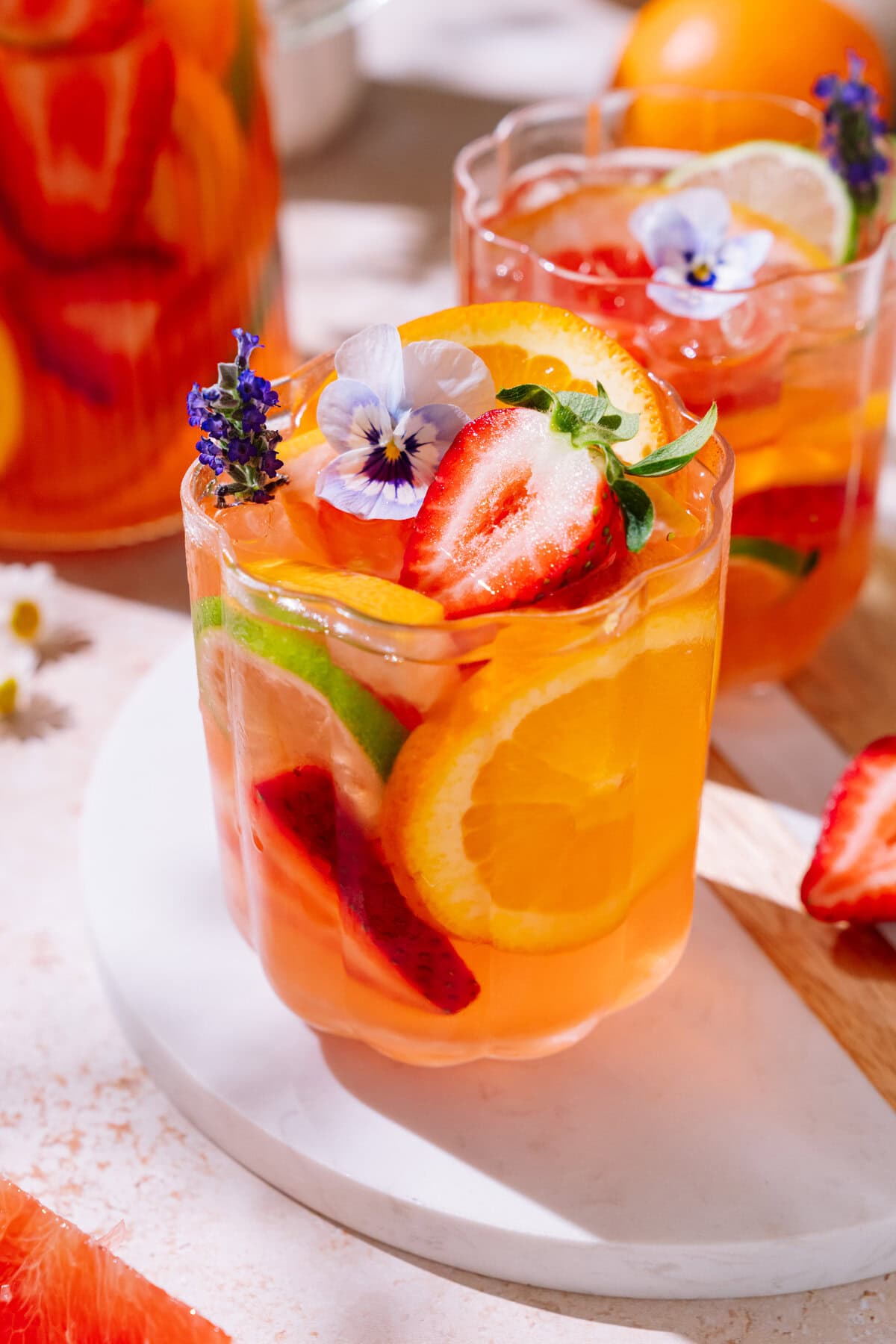
Cover photo. Most people think of red sangria (made with red wine) during the cold months, but this white sangria will satisfy all your guests who prefer white wine or like sangrias. It does require a significant amount of prep and time in the kitchen, but it is so worth it for your holiday parties or get togethers. To make mocktail, replace Pinot Grigio with white grape juice.

  • 3 large oranges
  • 1 small lemon, plus lemon wedges for rims of glasses
  • 1 (2-inch) piece fresh ginger, peeled, halved lengthwise, and smashed (optional). For ease, you can leave out or sub crystallized 1/2 oz ginger liqueur, ground ginger (very potent so use very little)
  • 1 cup granulated sugar, divided
  • 2 (750-ml) bottles dry Pinot Grigio
  • 5 whole star anise
  • 2 cinnamon sticks
  • 1 teaspoon vanilla extract
  • Pinch of kosher salt

Prep –

  • Using a vegetable peeler, remove peel in wide strips from 2 oranges and from half of the lemon. Juice lemon to equal 2 tablespoons juice; set juice aside.
  • Heat orange peels, lemon peels, ginger (opt), and 1/2 cup sugar in a large saucepan over medium-high. Cook, stirring and scraping bottom and sides of pan constantly with a wooden spoon, until sugar crystallizes and turns golden brown, 7 to 9 minutes. (The sugar will melt and then crystallize, forming small pebbles.) Slowly stir in 1 bottle of wine/grape juice Slowly stir in second bottle of wine/grape juice; add star anise, cinnamon sticks, vanilla, and reserved 2 tablespoons lemon juice. Reduce heat to medium-low, partially cover, and bring mixture to a vigorous simmer. Reduce heat to low, and simmer 10 minutes. Remove pan from heat and let mixture steep 20 minutes.
  • Meanwhile, grate remaining orange to equal 1 packed tablespoon grated zest. Combine orange zest, salt, and remaining 1/2 cup sugar in a small bowl. Using the back of a spoon, stir and crush mixture until mixture is fragrant and has an orange tint; set aside.
  • Return pan to heat over medium, and cook, stirring occasionally, until warmed through, about 4 minutes. Pour wine mixture through a fine wire-mesh strainer into a large heatproof bowl; discard solids.
  • Rub rims of heatproof glasses or mugs with a lemon wedge; dip rims of glasses into orange zest–sugar mixture. Carefully ladle mulled wine into glasses, and serve warm.

If You Love Pinot Noir, Try These & Other Seasonal Wines

Thanksgiving Pinot Noir
November
26
2024

If you haven’t picked up your Thanksgiving wine yet, then use this guide for your shopping. There are many options, whether it be white, red, rose, or sparkling, for all your guests’ diverse palates. Because of the season, I tend to focus on reds for the holiday season now through Christmas. Of course, the holidays are a celebratory time for many so a sparkling or that special bottle in the cellar would suffice.

If you prefer whites or roses that would pair well with turkey dinner or is your go-to, then you are set. I have the snob-less philosophy of drinking what you and your guests like regardless of the food, season, or what the wine snobs say. After the holiday is over and your guests depart, you are left with wine you can enjoy yourself.

I may be a little biased (I write about it a lot), but I feel that Pinot Noir is a happy medium no matter what you like. Not only is it a lighter and medium style of red with low to medium tannins and good acidity, but is food-friendly and pairs incredibly well with all the Thanksgiving fixings and turkey. It is also approachable for non-red wine drinkers and those who prefer not to sip a heavy, tannic red with or without food.

In the realm of Pinot Noir, there are many different styles produced around the world (some of which are new and upcoming regions rarely explored) with varying flavor profiles that won’t require you to spend upwards of $30. The price point on good quality Pinot from Burgundy, California from Russian River Valley, and some Oregon from Willamette Valley will cost you. See my previous Pinot posts on the blog. If price isn’t an issue and you prefer those styles of Pinot Noir, then go for it. 

Below you will find my value PN recommendations for the holiday season along with other reds and whites that will match your menu and satisfy your guests regardless of their wine preferences for under 30 bucks. Most Pinot Noir enthusiasts know about and have tried Pinot from California, Oregon, and Burgundy, but who else in the world produces fine Pinot that actually fits the season better and won’t cost you an arm and leg? 

I have recently discovered some excellent PN from Germany and the Alsace region of France, both of which are well known for Riesling and the latter for sparkling wine as well, which often contains a percentage of Pinot Noir in its blend or 100% Pinot Noir. Some other countries and regions produce excellent Pinot Noir which can be drunk all year long, but ones from these places are ideal right now and throughout winter.  

Bright, juicy, and easy to drink Pinot Noir from Alsace in the northeast corner of France is definitely under the radar. If you’re not a wine scholar, you may not be familiar with PN from France not named “Burgundy” or “Bourgogne”. It has grown in Alsace since the Middle Ages. Pinot Noir was considered a table wine at the time so it was overlooked in the original 1975 decree of the Alsace grand cru designation as well as in later revisions, until the designation changed in 2022. Wow! that’s recent!

Created as a pure expression of the fruit, Alsatian Pinot Noir is generally made in an unoaked style and is the only red variety allowed to be grown in the regional cru, or vineyard classification system, in Alsace. 

The wines from here are medium-bodied and offer fresh red berry notes of strawberry, raspberry, and cherry. When some oak is used, the wines are well-balanced and add warm baking spices to the red berry flavors. 

Many Alsatian Pinot Noir wines reflect a Burgundian style of winemaking showing elegance and the ability to age for a decade or two. These Pinots offer awesome value when compared to average price points of wines from Burgundy. Alsatian wines are also leaner than wines from warmer regions, like California and Australia. They also offer more red berry fruit than the dark, cherry flavors found in Oregon Pinot Noir.

Cremant d’Alsace rosé, or pink sparkling wine from the region made in the traditional style using 100% Pinot Noir grapes, is a light and lively sparkler with soft aromas of strawberry and cherry blossoms with some round peach, floral, and raspberry notes on the palate.  

What about German Pinot Noir? Did you know that Germany produces Pinot Noir? Well, it makes sense considering the climate and overall geographic location and proximity to Alsace. Alsace and Germany are close neighbors. German PN is not well known and goes unappreciated due to the lack of exposure worldwide, lack of exports, and what it is sometimes called. It is a very splendid style of Pinot right now.

The German word for Pinot Noir is Spätburgunder, translating to “late” (spät), referring to the grape’s later ripening when compared to other Pinot clones, and Burgundy (Burgunder), the antiquated term for Pinot Noir. 

German Pinot Noir is typically light in color, body, and tannins, with flavors of cranberry, cherry, baking spice, and a stony minerality. Some can be earthy and savory, but the general consensus is that it contains a bigger fruit and more acidity than most Pinots. Traditional German Pinot Noir is lighter than Pinot Noir from warmer climates and Alsace, but some contemporary winemakers are producing fuller-bodied wines similar to Alsace.

Other great styles of wine for the season include:

Reds – Beaujolais/Gamay/Gamay Noir (France), Cabernet Franc (France, NY, Virginia, Chile), Zinfandel/Primitivo (California, Italy), Blaufrankisch/Lemberger (NY, Germany, Austria)

Whites – Riesling/Semi-Dry Riesling (NY, Mosel, Germany, Austria, Alsace, France, Washington State), Gewurztraminer (Alsace, France, NY, Italy), Gruner Veltliner (Austria, NY)

Any Sparkling/Champagne – Blanc de Noirs (Pinot Noir) from NY, France, and California and Rose Champagnes are excellent choices.

Shopping List 

Check your wine rack or cellar for the wines above, but if you are looking to stock up for the holidays and season, then look for these wines by grape varietal, country, and region. The list below includes Pinot Noir, Beaujolais, Cabernet Franc, and Riesling.

Pinot Noir

Jürgen Leiner ‘Handwerk’ Pinot Noir 2022 (Germany), $24

Borell-Diehl ‘BD’ Pinot Noir 2021 (Germany), $14

August Kesseler ‘The Daily August’ Pinot Noir 2022 (Germany), $27

Terres d’étoiles Pinot Noir 2023 (Alsace, France), $22

Allimant-Laugner Pinot Noir 2022 (Alsace, France), $20

Domaine Bechtold Obere Hund Pinot Noir 2021 (Alsace, France), $29

Other red wines (under $30)

Maison L’Envoye Fleurie Château Vivier 2022 (Beaujolais, France), $21

Domaine Dupeuble Pere et Fils Beaujolais 2022, $20

Lamoreaux Landing T23 Unoaked Cabernet Franc 2022 (Finger Lakes, NY)

Macari Lifeforce Cabernet Franc 2022 (North Folk Long Island, NY)

Heron Hill Winery Classic Cabernet Franc 2020 (Finger Lakes, NY)

Whites (Under $30)

Anthony Road Finger Lakes Dry Riesling 2020

Thirsty Owl Wine Company, Dry Riesling 2019

Weis Vineyards Reserve or Dry Riesling 2019

Wine Glass

DON’T MISS A DROP

Get notified when new articles are poured

We don’t spam!