Wine Spotlight: Getting to Know Beaujolais Wine

November
20
2025

“Happy Beaujolais Nouveau Day 2025”

Beaujolais Nouveau is a light, fruity red wine from the Beaujolais region of France made from the Gamay grape. It is released on the third Thursday of November every year. It is known for its easy-drinking and juicy quality with notes of banana and strawberry, served slightly chilled, and has become a celebration of young wine worldwide.  Its popularity is largely due to marketing efforts in the mid-20th century that promoted a race to get the first bottles to Paris.  

The Gamay grape is also grown in parts of New York State and the Finger Lakes region due to the cool climate and longitude and latitude proximity. Try the Gamay Noir from Sheldrake Point Winery on the west side of Cayuga Lake. You will not find too many Gamay in the marketplace. I did recently indulge in one at Noble Cellar in downtown Syracuse NY. If you do find one in a local shop, expect to only pay around $20–$25.
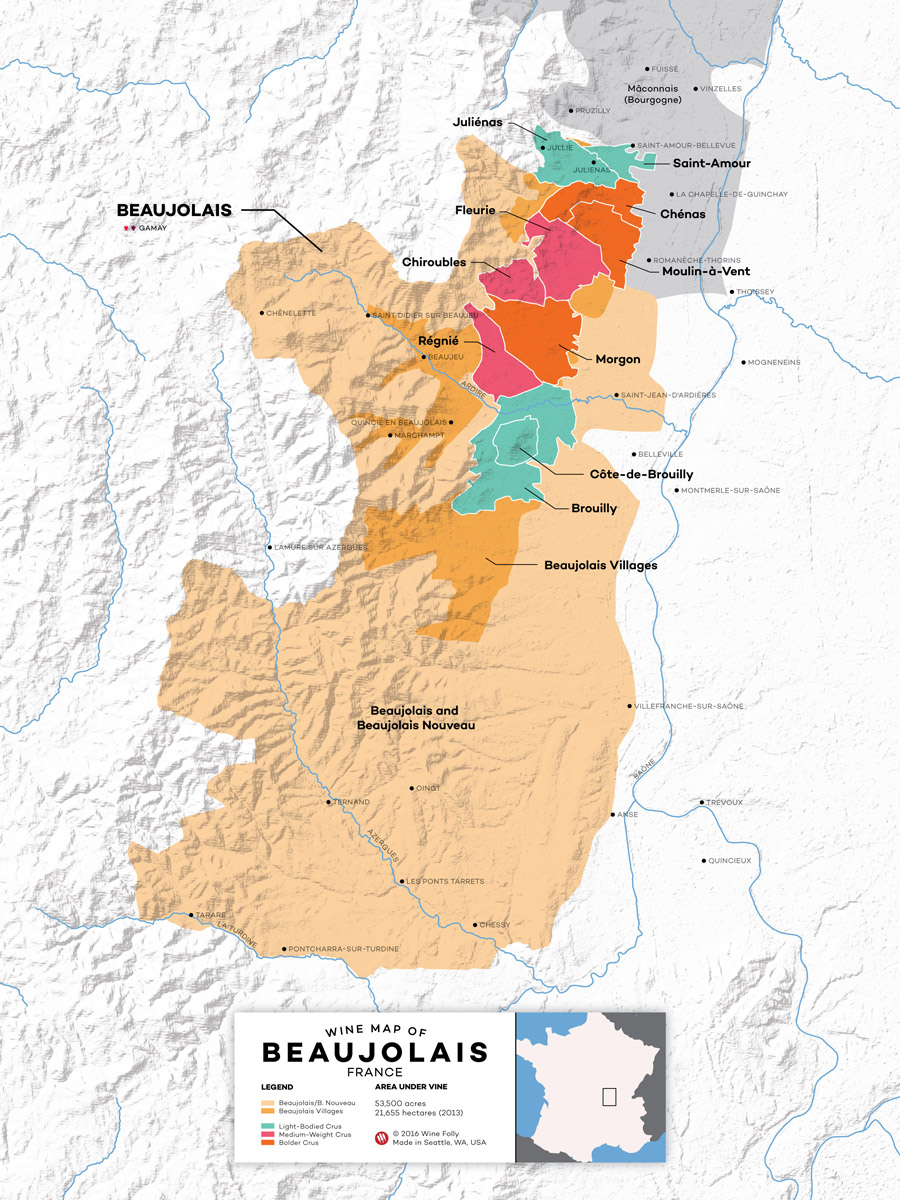
Beaujolais is the name of a little area in France just south of the Burgundy region. It is one of the few wine regions of France that has a more casual approach. Historically, Beaujolais has been considered a part of Burgundy, but today it stands alone producing high quality, signature wines. The more serious cru designations of Beaujolais drink very much like a red Burgundy (Pinot Noir). Beaujolais is arguably one of the lightest reds you will encounter.

Where is Beaujolais?

  • Bordered by Burgundy to the North – the Saône River (which leads to Côtes du Rhône) to the East – the “Gastronomic Capital of France”, Lyon, to the South – and the Monts de Beaujolais (the hills of the Massif Central) on the West.
  • Beaujolais is just 34 miles long and 7-9 miles wide.
  • Divided into two sections by the Nizerand River, with different soils on each side.
  • Beaujolais’ flavor is in the soil. There are mostly granite and schist (decomposed rock) to the North and clay-based soils (marl) to the South.
  • All of the Beaujolais Cru vineyards are located on the northern side of Beaujolais.

10 Beaujolais Crus

The crème de la crème of Beaujolais!

There are 10 Crus of Beaujolais – all in the north and producing only red wines. The wine labels will simply state the name of the Cru, like Fleurie.

Each Beaujolais cru has its own distinct personality – climate, soils, altitude, aspect, and a host of other factors that are unique. These wines tend to be more complex and known to age well.

The Romans were the first to plant vineyards – to keep legionnaires happy! – followed by the Benedictine monks in the Middle Ages.

It was the Dukes of Beaujeu who made the wines fashionable. Originally, the town of Lyon was the main market for Beaujolais wine.

When the railroads were built in the 19th century, Beaujolais spread to Paris. This marked the start of its popularity.

Some of my regional favorites below, which may be partly due to their distribution and accessibility in the states.

Moulin-à-Vent

Considered “The King of Beaujolais,” this sub-region’s vineyards are grown on decomposed pink granite and soft flaky quartz giving the wines a dark ruby/garnet color, good structure and complexity. These are the most tannic and full-bodied wines of all the Cru.

When they’re young you’ll notice lots of plum, cherry and violet notes, but if you can allow the wine to age up to 10 years you’ll be rewarded with more ‘Pinot’ style – dried fruits, earthy truffles, meat and spice. Moulin-à-Vent gets its name from a local windmill.
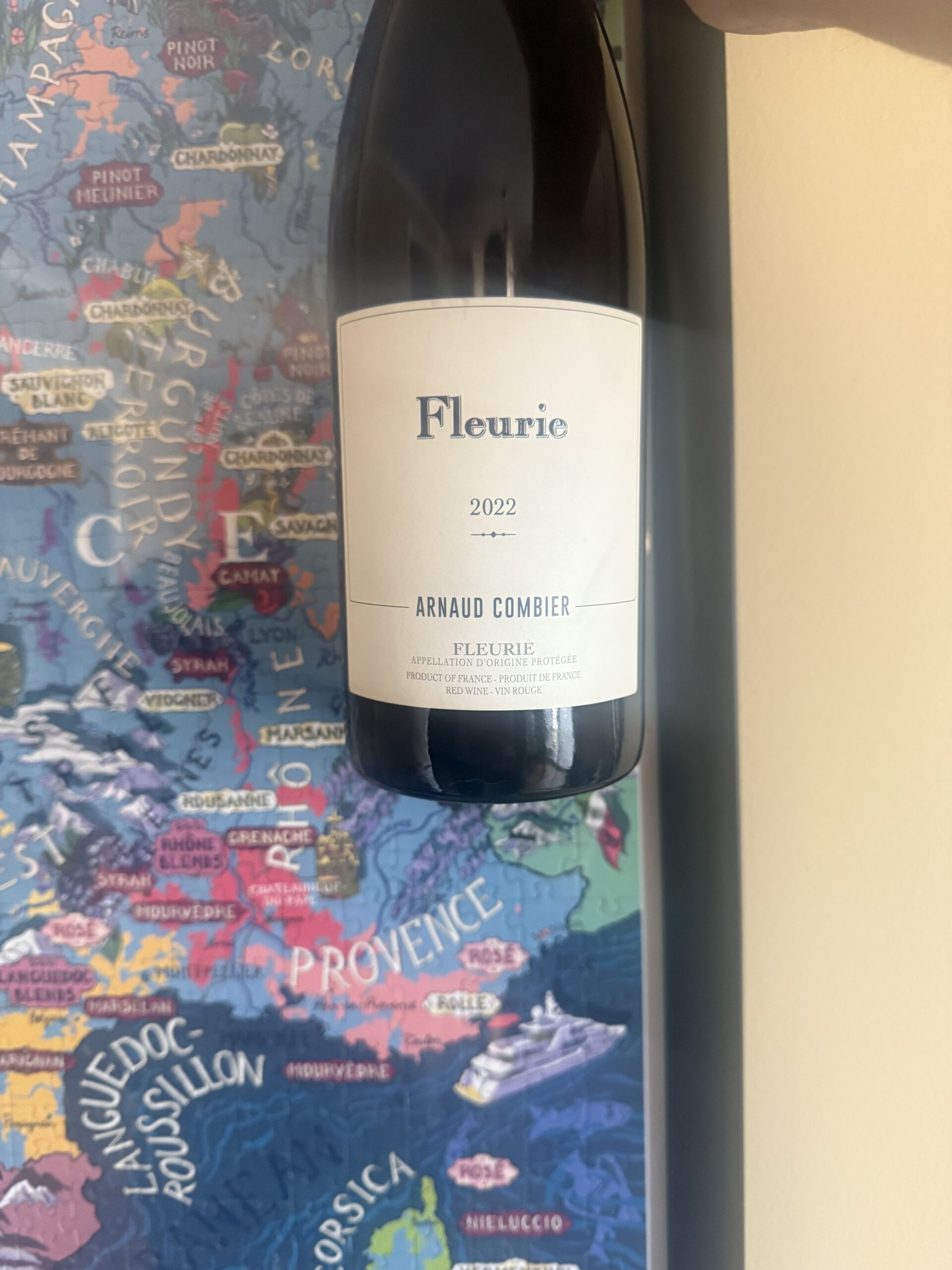
Fleurie

“The Queen of Beaujolais.” The vineyards are planted at a higher altitude on the steep slopes at the foot of La Madone.

The wines are lighter in style and highly aromatic with a ’feminine’ quality. Think roses, iris and violet along with some ripe red fruits and peach. If you’re just getting into Beaujolais, the wines of Fleurie are a great place to start. This one pictured from Angel’s Share in Clay NY is fantastic!

Morgon

The second largest of the Crus, Morgon is comprised of six climat all with slightly different styles. Their unifying feature is the decomposed “rotted rocks”. The locals believe this contributes to the ripe cherry aromas found in all the wines.

These wines are intended to age at least 5–10 years. The young, fleshy palate of peach, apricot, cherry, and plum will develop into a more earthy wine reminiscent of Burgundian Pinot Noir, similar to a Moulin above.

Why Does Beaujolais Taste Like Bananas?

One of the things that sets Beaujolais apart is a particular style of winemaking that is extremely well suited to the Gamay grape. Most of the wines of Beaujolais are produced through a method known as semi-carbonic maceration that highlights the amazing fruity aromas of the wine. You see this technique being used more often in cool climate reds around the world. Regionally, you see it done with Cabernet Franc and Pinot Noir.

The grapes are harvested and then, instead of being crushed, the whole clusters are placed in a vat or tank. The pressure of the fruit begins to crush the grapes near the bottom of the vat, expressing their juice. When the juice comes into contact with the indigenous yeast on the grape skins, the juice starts to ferment creating CO2 gas – aka carbon dioxide – which forces the oxygen out of the tank. Often, a lid is placed on the tank to help eliminate the oxygen as well.

After a short maceration period of around 4-8 days, the juice is racked off (the ‘free run”) and the remaining juice is pressed from the skins (the ‘hard press’), then the two are blended together. From this stage the juice will finish fermentation and completed as a ‘regular’ wine.

This style of fermentation is also responsible for the distinctive aromas of banana, candied fruits, pear, raspberry and cranberry in the finished wine.

(I know this is technical stuff that many of you, unless you’re a wine geek, don’t have an interest in. I bring it up to help you better understand what makes this wine different from others.)

I hope you enjoyed this little primer on Beaujolais wine and the Gamay grape. If you come across any of these wines, please share with me. As you know, I’m always on the lookout for new wines, but especially light reds. Btw, this style of red wine is very approachable, a great intro to red wine, and for those who don’t like red wine. It is also perfect to sip in the summer months and very food-friendly with its acid content and light style. Grab a bottle for Thanksgiving and let everyone try it.

Cheers,

Michael

Wine Spotlight: Riesling Primer, Riesling Day & Recs

International Riesling Day
March
10
2024

To get things started, let’s discuss a topic that I am passionate about – wine #grapes and the #wines they produce. As we approach spring and celebrate annual “International Riesling Day” on March 13th, what better time to talk about the noble grape, #Riesling, which happens to be the signature grape of the Finger Lakes, NY where I call home.

It is so popular here that they dedicate a whole week of events centered around Geneva, NY, located at the northern tip of Seneca Lake. The week-long event is called “FLXcursion” or The Finger Lakes Riesling Wine Conference. It is an international gathering of Riesling regions and producers from around the globe. International Riesling Day is a toast to this versatile, bright, and aromatic grape. Let’s take a closer look at this grape, which is grown and produced in many different parts of the world.

Riesling is considered by many to be the most noble and distinctive white grape variety. The grape is thought to have originated in the Rheingau region of Germany.

The best Riesling has elevated acidity, aromatic, unique sense of purity, and vivid aroma and flavor. The wine is graceful and light on the palate. It’s refined and layered structure along with mouthwatering, delicate flavors that include ripe peaches and apricots (stone fruits) to melon (tropical fruit) to lemons, oranges, and grapefruit (citrus fruits) with vibrant minerality, like the taste of clean water running over stones in a mountain stream. A dangerously easy to drink wine.

Riesling grapes

More than almost every other white grape, Riesling is temperamental about where it is planted. It doesn’t grow well in very warm places, and even in cooler locations, the quality and character of the wine can vary. The most elegant and precise Rieslings come from cooler climate regions, like New York, Washington state, parts of Australia, France, Germany, Canada, Slovenia, and Austria. You can also find great Rieslings made in cooler pockets within a warm climate. In the cool districts of the Clare and Eden valleys of Australia (tends to have more petrol notes), the top Rieslings are minerally, vibrantly fresh, citrusy, and tight (wine speak for high acidity).

It is not a wine you can just chug. Most sommeliers and wine professionals agree that you’re more likely to stop and think about what you’re drinking. If you’re having a great meal and want something to hold up to it, Riesling should be on the table. Riesling is one of the most flexible food wines thanks to its soaring acidity and is relatively inexpensive. It cuts through the acid in the food and enhances your experience.

Aged Rieslings are some of the most prized wines out there because it’s strong ability to age well with its higher acidity level and some residual sugar (sugar left over after fermentation).

A common assumption about Riesling is that it is sweet or semi-sweet. That is not correct. Unfortunately, consumers have been only exposed to the highly commercial ones available in the US, which tend to be on the sweeter side. If you live in Finger Lakes wine country, like I do, you will find most of the Rieslings are dry. In fact, most of the top Rieslings in the world are dry, except for those that are made intentionally made sweeter, like ice wines and late harvest wines.

Some of the confusion about the sweetness levels of Riesling happens because when you discover a wine that is fruity, you assume its sweet. It’s easy to confuse fruitiness with sweetness. Quick tip – when you sip a wine, hold your nose, and if the wine tastes sweet on the tongue (specifically the tip of the tongue), then it is a sweeter wine. If not, then it has little residual sugar and is therefore fruity. Another way to determine sweetness is to look at the alcohol content. Once you go above 12%, it gets drier. Look for the word trocken “dry” on the label.

To help clarify where a Riesling stands in terms of its taste (for shopping purposes and to get what you want), the International Riesling Foundation (IRF) created a scale/taste profile chart based on the ratio of sugar to acid in the wine. This could also be helpful to those who are diabetic or don’t want to consume a lot of sugar. You will find the chart on the back label of many Rieslings. The spectrum shows from dry to medium dry to medium sweet to sweet and pinpoints where that wine falls on the spectrum.

Try these foods with dry Rieslings

Raw, cured and smoked fish, particularly salmon and trout though any selection of smoked fish should work well as you’ll see from this pairing for cured salmon. Also sushi, particularly with the slight touch of sugar you get in sushi rice.

Fresh or lightly dressed shellfish, prawns, shrimp, fresh crab, or seafood cocktail. Fish dishes with a creamy sauce.

Pork, particularly fatty cuts like pork belly, better if with some kind of apple or bacon chutney or sauce.

Poultry

Goat cheeses. Young Riesling with young goat cheese, but an aged Riesling with a mature goat cheese is better.

Try these foods with medium dry or off dry Rieslings

Just think spice. So many spicy dishes work with an off-dry Riesling – Thai, Vietnamese, even Indian. The hotter the dish the sweeter the Riesling, basically.

Asian-style salads, Thai beef salad, spicy noodles, goose, duck, pork, roasted and aromatic veggies, cucumber soup

If you would like to learn more about Riesling and the specific regions it hails from, please let me know. This post would be a dissertation if I discussed every aspect of the grape and the wine. If you would like wine recommendations, just reach out. There are so many different styles for every palate out there. Because my body can’t tolerate high acid wines, I tend to drink more semi-dry Rieslings than dry because it has a lower acid content. Personally, I am more of a Pinot Gris, Sauvignon Blanc, and Chardonnay wine fan. If you would like wine recommendations, just reach out.

I listed some highly rated local (pricier than most world Rieslings) and worldly Rieslings (great value too) to enjoy with food and during spring and summer months. Look for these online or at your favorite winery and shop. Your feedback is always welcome and encouraged.

Finger Lakes

Hermann J. Wiemer Flower Day Riesling 2022

Hermann J Wiemer Semi-Dry Riesling 2022

Nathan Kendall ‘Nathan K.’ Dry Riesling 2021

Anthony Road Wine Company Dry Riesling 2021

Forge Cellars Riesling Classique Finger Lakes (every vintage since 2015)

Weis 2019 Dry Riesling Finger Lakes

Hillick & Hobbs Estate Dry Riesling 2021

Boundary Breaks Dry Riesling Finger Lakes No. 239, 2019

Dr. Konstantin Frank Dry Riesling Finger Lakes (every vintage)

World

Dandelion Vineyards ‘Enchanted Garden of the Eden Valley’ Riesling 2022 (Australia)

Best’s Great Western Riesling 2022 (Australia)

Koehler-Ruprecht Kallstadter ‘Saumagen’ Riesling Kabinett Trocken 2021 (Germany)

Leon Manbach Riesling Grand Cru Frankstein 2019 (France)

Weinhaus Ress Riesling Trocken 2021 (Germany)

Trefethen 2019 Estate Grown Dry Riesling Oak Knoll District (Oregon)

Montinore 2019 Almost Dry Riesling (Oregon)

Fess Parker 2019 Rodney’s Vineyard Riesling (California)

Enjoy! Sante! Cheers! Prost!

Michael

Wine Glass

DON’T MISS A DROP

Get notified when new articles are poured

We don’t spam!