Mixology School: Guide to Martinis & Manhattans

Classic Martini
July
19
2024

MARTINIS 

The first question you should ask is – Would you like it “Straight Up” or “On the Rocks”?

Next question –  Do you prefer Gin or Vodka? Based on response, offer a ‘call’ brand (Beefeater gin or Absolut vodka) and ‘premium’ brand (Tanqueray No. Ten gin or Grey Goose vodka).

If requested straight-up, all martinis go into a chilled cocktail glass or coupe glass and are stirred, not shaken, unless requested shaken. Essentially due to increased dilution leading to subdued spirit, ice chips, presentation – lack clarity, and classic way of serving. You can achieve same amount of chill by stirring a little longer than shaking. Suggest a side of used rocks from mixing for hydration and extra chill. If requested ‘on the rocks’, build ingredients in an ice-filled rocks glass.

*Ratio of ingredients are the same for straight-up or on the rocks*. If Ingredients don’t all fit in the rocks glass, pour less vermouth/more spirit. All martinis should = 3 oz total volume and should never reach the rim of glass. Of course, after stirring or shaking, it will be a little over 3 oz, but shouldn’t be overfilled. If you have a larger martini glass, inform the guest so they don’t think you are underpouring them.

Grab my book to read a lengthy discussion on “The Martini”
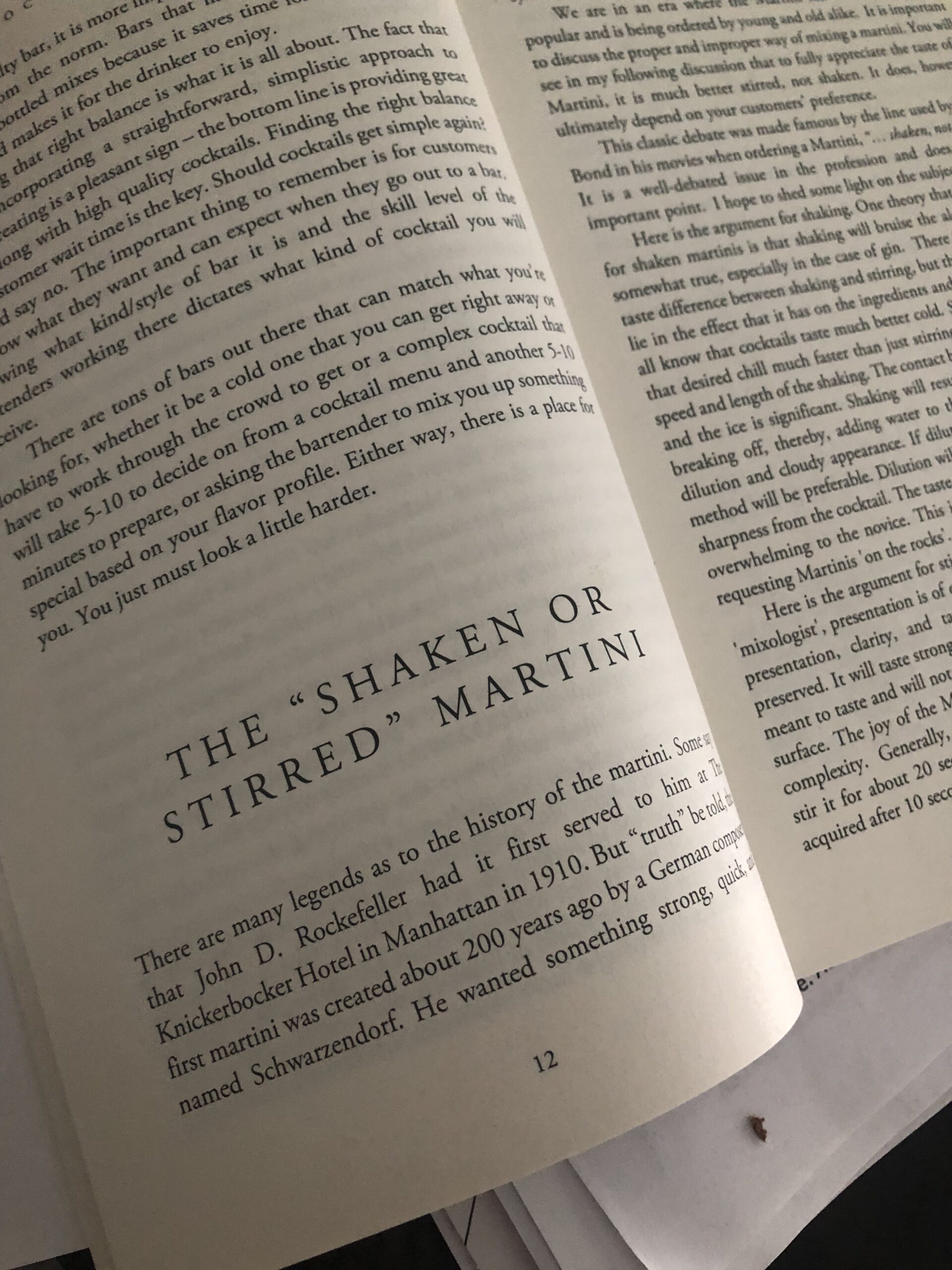
Book excerpt

Standard Martini recipe

  • 2 ½ oz Gin or Vodka (Bombay or Belvedere)
  • ½ oz Dry Vermouth
  • Garnish with olives on a pick or skewer (lemon twist/lemon peel upon request)
  • Chilled cocktail glass or coupe or larger rocks glass

Prep for straight-up martinis –

  1. Chill cocktail glass or coupe with ice and soda water and set aside if glass isn’t chilled. If already chilled, leave in the fridge until ready to pour.
  2. Grab a mixing glass, not silver tin, and add one scoop of ice. The reason for just 1 scoop is because of the surface area of liquid to ice (chilling ease) and the fact that you are stirring. Same concept as using a large ice cube for a spirit on the rocks. Add vermouth and spirit and stir gently with a long bar spoon for 20 seconds clockwise and counterclockwise.
  3. Grab cocktail glass. Using a julep strainer (curved strainer with holes), strain contents into cocktail glass. Garnish olives or lemon twist and serve immediately. If lemon twist or peel, rub the rim with skin from 12 o’clock to 6 o’clock. Twist over drink to release the oils and drop in. 
  4. To make lemon twist, use a channel knife around the width of lemon and curl around finger to create a twist. To make lemon peel, use a vegetable peeler and cut off a three-inch skin.
  5. Always place a cocktail napkin in front of the guest. Some guests request a side of the used rocks from the mixing glass. Add to a rocks glass and serve.
  6. If requested ‘shaken’, add full ice to the mixing glass, and shake with silver tin for 10-15 seconds. Using a hawthorne strainer (springs), strain contents from mixing glass into cocktail glass, garnish, and serve immediately.

Prep for martinis ‘on the rocks’ –

  • Build ingredients in an ice-filled rocks glass, stir gently with bar spoon for 10 seconds, add garnish and straw, and serve.

Dry Martini 

  • 2 ¾ oz Gin or Vodka (Tanqueray or Ketel One) 
  • ¼ oz Dry Vermouth
  • same garnishes and glassware 

Extra Dry Martini

  • same as Dry Martini with just a splash of dry vermouth

Bone Dry Martini

  • no vermouth/all spirit. Guests will say “no vermouth” 

Wet Martini

  • 2 oz Gin or Vodka
  • 1 oz Dry Vermouth
  • same garnishes and glassware

Gimlet

  • Standard Martini with fresh lime juice instead of dry vermouth. Same ratio as standard martini. Garnish lime slice.

Gibson

  • Standard Martini with cocktail onions as garnish. Same ratio as standard martini.

Dirty Martini

  • 2 oz Gin or Vodka (usually vodka)
  • ½ oz Dry Vermouth
  • ½ oz olive brine (store bought, not strained from olive jar)
  • Garnish with olives on a pick or skewer (no lemon twist)

* For extra dirty/very dirty, eliminate dry vermouth and add another ½ oz of olive brine

In & Out Martini

  • Add ½ oz dry vermouth to the chilled cocktail glass and swirl around to flavor the glass and dump. Or add ½ oz dry vermouth to mixing glass with ice and stir to flavor the ice, then strain out. Make martini as you would with Bone Dry Martini (3 oz spirit).

Classic Manhattan

MANHATTANS

The first question you should ask is – Would you like it “Straight Up” or “On the Rocks”?

Next question –  What kind of whiskey would you like? Bourbon, Rye, Blended, Scotch, Irish…..Based on response, offer a ‘call’ brand (Bulleit or Crown Royal) and ‘premium’ brand (Angel’s Envy or Jefferson’s ). If no preference, use Bourbon

If requested straight-up, all Manhattans go into a chilled cocktail glass or coupe glass and are stirred, not shaken, unless requested shaken. Will explain the reasons separately. If requested ‘on the rocks’, build ingredients in an ice-filled rocks glass.

*Ratio of ingredients are the same for straight-up or on the rocks*. If Ingredients don’t all fit in the rocks glass, pour less vermouth/more spirit. All Manhattans should = 3 oz and should never reach the rim of glass. Of course, after stirring or shaking, it will be a little over 3 oz, but shouldn’t be overfilled. If you have a larger cocktail glass, inform the guest so they don’t think you are underpouring them.

Book Promo

Standard Manhattan recipe

  • 2 ½ oz Whiskey (Knob Creek Bourbon or Michter’s Rye)
  • ½ oz Sweet Vermouth
  • 2-3 dashes of Angostura bitters or orange bitters (orange is my preference)
  • Garnish with luxardo cherry on a pick or skewer  (lemon twist/peel upon request)
  • Chilled cocktail glass or coupe or larger rocks glass

Prep for straight-up manhattans –

  1. Chill cocktail glass or coupe with ice and soda water and set aside if glass isn’t chilled. If already chilled, leave in the fridge until ready to pour.
  2. Grab a mixing glass, not silver tin, and add one scoop of ice. The reason for just 1 scoop is because of the surface area of liquid to ice (chilling ease) and the fact that you are stirring. Same concept as using a large ice cube for a spirit on the rocks. Add vermouth, spirit, and bitters and stir gently with a long bar spoon for 20 seconds clockwise and counterclockwise.
  3. Grab cocktail glass. Using a julep strainer (curved strainer with holes), strain contents into cocktail glass. Garnish luxardo cherry or lemon twist and serve immediately. If lemon twist, rub the rim with skin from 12 o’clock to 6 o’clock. 
  4. Twist over drink to release the oils and drop in. 
  5. To make lemon twist, use a channel knife around the width of  lemon and curl around finger to create a twist. To make lemon peel, use a vegetable peeler and cut off a three-inch skin.
  6. Always place a cocktail napkin in front of guest. Some guests request a side of the used rocks from the mixing glass. Add to a rocks glass and serve.
  7. If requested ‘shaken’, add full ice to the mixing glass, and shake with silver tin for 10-15 seconds. Using a hawthorne strainer (strainer with springs), strain contents from mixing glass into cocktail glass, garnish, and serve immediately.

Prep for manhattans ‘on the rocks’ –

Build ingredients in an ice-filled rocks glass, stir gently with a bar spoon for 10 seconds, add garnish and straw, and serve.

Dry Manhattan

  • 2 ½ oz Whiskey (Bulleit or Blanton’s Bourbon)
  • ½ oz Dry Vermouth
  • 2-3 dashes of Angostura or orange bitters
  • Garnish lemon twist or peel, not cherry, same glassware 

Perfect Manhattan

  • 2 ½ oz Whiskey
  • ¼ oz Dry Vermouth
  • ¼ oz Sweet Vermouth

2-3 dashes of Angostura or orange bitters

  • same garnishes and glassware 

Rob Roy

  • 2 ½ oz Scotch Whiskey (Dewars or Ardbeg)
  • ½ oz Sweet Vermouth
  • 2-3 dashes of Angostura or orange bitters
  • same garnishes and glassware 

Perfect Rob Roy

  • 2 ½ oz Scotch Whiskey
  • ¼ oz Dry Vermouth
  • ¼ oz Sweet Vermouth
  • 2-3 dashes of Angostura or orange bitters
  • same garnishes and glassware 

Martini & Manhattan drinkers are often very specific. They will tell you how they want it. If not, adhere to these rules. Flavored martinis are always shaken, i.e. Cosmopolitan. Flavored martinis always have some mixer/juice, modifier, and liqueur. Will discuss them separately.….Cheers. Michael
Bar Spotlight: How to Order Drinks Like a Pro

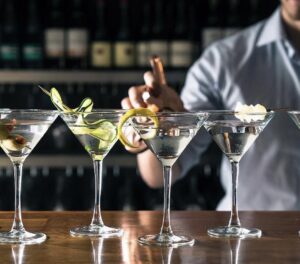
Martinis Display on Bar
July
2
2024

In the current craft cocktail climate, it may seem like all your friends have their favorite cocktails put to memory, but not everyone is skilled in the ways of mixology.

For the novice, ordering a drink can be a daunting task. Even if you know exactly what you want, it can be hard for the bartender to understand your request. Cocktail ordering can be confusing for a lot of people. Bartenders want their guests to be happy with their cocktail and with the cost of craft cocktails today, bar guests want to be happy as well. The key is communication with your bartender or server.

You can order the same drink in 10 different bars and get 10 different variations, especially with the plethora of liquor and mixers in the marketplace. Any variable can change the drink you like.
If you like a drink to be made a specific way, let your bartender know exactly how you want it made because they will make it the way they know best or the way they like it themselves.

Fake it till you make it. Order a drink that you are curious about and order it confidently. Because the bartender wants to make you happy (remember their livelihood), they will often share details about a drink or suggest what they make well. Bartenders have a lot of pride.

If you’re expanding your drink experience, pick your time wisely. People walk into a bar and order what they think they know. When they want to order outside their comfort zone, they don’t know what to order. If they want to try a new fancy drink, then pick a time when the bartender is not in the weeds.

Since drinking establishments can be fast-paced, chaotic, and noisy places, it’s not easy to have a conversation across the bar. Fortunately, there is bar lingo that you can use for ordering drinks. Getting to know the lingo, what they mean, and when to use them, can be helpful. These terms will help you learn how to order a cocktail like a pro.

NEAT

When you just want to sip one spirit or liqueur with no ice, no mixer, and unchilled, order your drink ‘neat’. Order: “I’d like a bourbon, neat.” For a specific brand, say “I’d like a Maker’s Mark, neat.” Typically poured into a snifter or old-fashioned glass. Ordering neat is a great way to get to know different types of spirits.

UP/STRAIGHT UP

A drink ordered ‘up’ will be either stirred or shaken with ice, and then typically strained and poured into a cocktail/martini or coupe glass . “Up” drinks are served in stemmed pre-chilled glasses to prevent warming of contents.

Many classic cocktails are served ‘up’ by default, including martinis, manhattans, and cosmopolitans. For many cocktails, you don’t need to ask for them ‘up’, as they will be served that way, but just in case, say “I’d like a vodka/Tito’s Gimlet, up”.

‘Straight up’ is a tricky term in bartending. The word ‘straight’ is sometimes used to mean the same thing as neat – room temperature, not served over ice. The word ‘up’ means chilled and strained. The term straight up could mean either one of these, therefore, never just say “straight up’.

If you’re ordering a cocktail that’s usually served up, the bartender will presume that’s what you mean. But if it’s a drink that’s not generally straight up, then clarify by saying, “I’d like a Tanqueray straight up and shaken”.

ON THE ROCKS

A drink served ‘on the rocks’ is simple to understand. It means served on ice. This then raises a question about ice. Many bars, particularly higher-end craft cocktail joints, will have different types of ice, and each will bring a different character to your drink.

The smaller the ice, the more surface area comes into contact with the alcohol, which leads to faster dilution. Large cubes or spheres that take up the biggest volume will dilute your drink at the slowest rate. Order a single spirit, “I’d like a whiskey/Jameson on the rocks”. If you want to specify ice, “I’d like a Negroni with a large cube.”

SHAKEN

If you like your drinks super cold and with lots of dilution, ordering them shaken is the way to get it. As a general bartending rule, certain cocktails are shaken by default, including anything that involves citrus, dairy, liqueurs, or egg whites.

Anything can be shaken, except carbonated ingredients. A shaken drink should always be poured into a pre-chilled glass. Order “I’d like a vodka/Belvedere martini, shaken.”

STIRRED

Stirring a cocktail is a way to chill it in a gentle manner. The ice slowly melts by adding dilution into the drink. This results in a cocktail with a different texture and a smoother mouthfeel.

The stirred method works best for cocktails that are spirit-forward, such as martinis and Manhattans. They are stirred as a rule for these reasons and to preserve clarity so always specify the method you prefer. A stirred drink should always be poured into a chilled glass. Order “I’d like a gin/Beefeater martini, stirred.”

Best of Luck out there! This guide should help you avoid embarrassment and solidify that you get the drink you ordered.

Cheers,

Michael

Rosé All Day: Intro to this Pink Wine

FLX Rose
April
29
2024

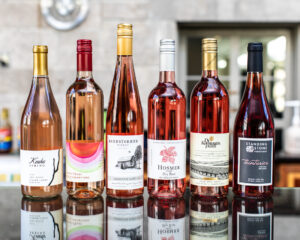
As a follow up to our incredible and successful Finger Lakes Wine Experience event last week, here is a brief history and facts about rosé wine. Contrary to popular belief, rosé wine is NOT made by mixing/blending white and red wine together to create ‘pink’ wine. Although, in its infancy, it was a rudimentary and common practice.

Modern Rosé most likely originated in the 6th century BC. The Greeks created the first pink wine in modern day Marseille, France, close to the Mediterranean in Southern France, but these attempts were off-dry and too tannic due to prolonged contact during fermentation.

Rosé (Rosado in Spain, Rosato in Italy) comes from red grapes that have been macerated for just a few hours up to 24 hours to extract a little bit of color from the skins. Maceration (most common) refers to a process of soaking grape must on the skins to extract color, aroma, and tannins. When the ideal color is achieved, the juice is filtered off the skins and fermentation like a white wine is completed. More similar to a white than a red in terms of aroma and flavor profile, light body, and acidity.

Another method called Saignee (sahn-yay) Method (french) or bleeding off is the process of draining some juice from a red wine fermentation to increase the concentration/used in a different vat. Leftover juice is used for a deep colored rose wine. 

Also, cold soaking is the process of resting the juice with the skins at a cold temp prior to fermentation. This helps extract more color and flavors from the skin.

Blending is the least common where you add a splash of red wine to a vat of white wine. Mostly done in the early days and frowned upon today unless you’re in Champagne, France where they use red and white grapes..

Rosés can range in color from pale pink (Bandol in France) -medium pink (Grenache or Grenache blend) -deep pink (Tavel) or pale salmon (Provence, White Zinfandel) -medium salmon (Sangiovese)-deep salmon (Syrah, Merlot). Sometimes Rosés can appear pale copper (Provence, Pinot Gris/Grigio), medium copper (Pinot Noir), or deep copper (Syrah). Color achieved is a result of maceration time, cool vs. warm climate, ripeness of grape skins, and varietal used. Any red/black grape can be used by itself or in combo with others.

Rosé is often a blend of different varietals, such as Mourvèdre, Pinot Noir, Grenache, Cab Franc around the world or just a single varietal. Sometimes a little bit of white is added. Much depends on the quality of vintage and ripeness of grape juice/skins.

In France, typically Grenache and Syrah in southern France and Cabernet Franc in northern France. In Italy, Rosato is made all over Italy using one or several local, indigenous varieties, but also Sangiovese (Italian grape found in Chianti). In Spain, Rosado is made from the signature grape Tempranillo and sometimes with Garnacha (same grape as Grenache found in France). In Argentina, the signature grape, Malbec, is used.

Best drank young (1-2 years). So, 2021 and 2022 vintages are ideal right now. The 2023 vintage which has been released in many regions, like the FLX, is very good, but may take a little time to mature and evolve in the bottle. Serve between 45-55 degrees – better cold to enhance the aromas, flavors and acidity.

It is one of the best wines for pairing with warm weather appetizers and light bites. Crisp, fruity, and vibrant, a light rosé with substantial acidity will offer a counterbalance to soft and mellow cheeses and fresh crudites without being overpowering. Try it with goat Gouda, Havarti, Feta, baby Swiss, and cheddar. Salty foods, such as prosciutto and nuts and olives on a charcuterie board are a delicious choice. It’s versatile and refreshing for summer picnics or time spent outdoors.

Lighter rosés (FLX, NY, Cali, Oregon) pair great with cheese, sushi, salads and seafood. The higher acidity makes it very food friendly. Bolder rosés (Old World/France & Italy) pair well with bolder foods, like pizza, BBQ, spicy foods, Asian cuisine, charcuterie, turkey, ham, heavier cheeses

The very driest rosés (watermelon, grapefruit, herbs) – look for Tavel and Grenache from Southern France and Languedoc Roussillon region.

Dry Rosé (melon, peppercorn, strawberry) – Pinot Noir, Tempranillo, Mourvèdre

Semi-Dry (plum, cherry, smoke) – Syrah and Cab Sauvignon

Off-dry (red fruits) – Sangiovese and Malbec

Sweet (raspberry, melon, strawberry) – White Zinfandel (sweeter) and Pink Moscato (sweeter and carbonated)

Rosé has seen an incredible spike in popularity in the US. In 2017, it was the number one fastest growing beverage category, with a 25% annual sales increase. The demand from Provence – a French region once looked down upon for its simple wines – has outstripped the grape supply. France produces and consumes more than any other region accounting for 30% of the world’s rosé. Rosé in Spain has grown exponentially and their Rosados have received international acclaim that are starting to rival the French.

If you would like to learn more about Rosé wine or want recommendations on the best ones to try, please reach out. Stay tuned for more blog posts like this all spring and summer. Look for fun wine tasting and food/wine pairing events as well as featuring different wines from around the globe and the Finger Lakes.

Cheers,

Michael Nagy

Interested In Learning More About Finger Lakes Wines?

Tasting Wine By Style
March
24
2024

Whether you’re an industry professional, wine enthusiast, or just getting into wine, The Michael Pour is offering a fun, practical, approachable, and interactive educational and tasting experience that takes you on a journey through FLX wines and wineries.

Learn about the history of the wine region and the winemaking process from grape to glass. It’s almost winery season here in the FLX so what a great time this spring to get immersed in their wine through tasting and education.

Below are some topics included. In addition, there will be an opportunity for a Q & A during and after your experience and access to food and wine at the establishment.

  • Identify the components of wine and how they affect your personal palate using sight, smell, and taste.
  • Learn how to taste using a systematic approach to tasting wine. We will taste one white, one rose, and one red.
  • Learn about basic food and wine pairings.
  • Explore various wine growing techniques and how geography and climate impact the grape.
  • Learn how to read and interpret wine bottle labels.
  • Learn what differentiates FLX wine from worldly wines.
  • Debunking wine myths and proper storage and service of wine.
  • Get recommendations on FLX wineries to visit and wines to explore.
  • Receive a wine tasting mat, handouts, and reference guide to aromas and flavors.

Wine tasting

Where: Starr’s Restaurant, 7 East Main St, Waterloo, NY

When: Thurs, April 25, 2024

Time: 6:00-8:30pm

Space will be limited to 12 people. Ticket price will be $25 per person through Eventbrite, which includes event, materials, wine tasting, access to food and drink at restaurant, and much more…. Book soon!

Cheers,

Michael

Wine Spotlight: Riesling Primer, Riesling Day & Recs

International Riesling Day
March
10
2024

To get things started, let’s discuss a topic that I am passionate about – wine #grapes and the #wines they produce. As we approach spring and celebrate annual “International Riesling Day” on March 13th, what better time to talk about the noble grape, #Riesling, which happens to be the signature grape of the Finger Lakes, NY where I call home.

It is so popular here that they dedicate a whole week of events centered around Geneva, NY, located at the northern tip of Seneca Lake. The week-long event is called “FLXcursion” or The Finger Lakes Riesling Wine Conference. It is an international gathering of Riesling regions and producers from around the globe. International Riesling Day is a toast to this versatile, bright, and aromatic grape. Let’s take a closer look at this grape, which is grown and produced in many different parts of the world.

Riesling is considered by many to be the most noble and distinctive white grape variety. The grape is thought to have originated in the Rheingau region of Germany.

The best Riesling has elevated acidity, aromatic, unique sense of purity, and vivid aroma and flavor. The wine is graceful and light on the palate. It’s refined and layered structure along with mouthwatering, delicate flavors that include ripe peaches and apricots (stone fruits) to melon (tropical fruit) to lemons, oranges, and grapefruit (citrus fruits) with vibrant minerality, like the taste of clean water running over stones in a mountain stream. A dangerously easy to drink wine.

Riesling grapes

More than almost every other white grape, Riesling is temperamental about where it is planted. It doesn’t grow well in very warm places, and even in cooler locations, the quality and character of the wine can vary. The most elegant and precise Rieslings come from cooler climate regions, like New York, Washington state, parts of Australia, France, Germany, Canada, Slovenia, and Austria. You can also find great Rieslings made in cooler pockets within a warm climate. In the cool districts of the Clare and Eden valleys of Australia (tends to have more petrol notes), the top Rieslings are minerally, vibrantly fresh, citrusy, and tight (wine speak for high acidity).

It is not a wine you can just chug. Most sommeliers and wine professionals agree that you’re more likely to stop and think about what you’re drinking. If you’re having a great meal and want something to hold up to it, Riesling should be on the table. Riesling is one of the most flexible food wines thanks to its soaring acidity and is relatively inexpensive. It cuts through the acid in the food and enhances your experience.

Aged Rieslings are some of the most prized wines out there because it’s strong ability to age well with its higher acidity level and some residual sugar (sugar left over after fermentation).

A common assumption about Riesling is that it is sweet or semi-sweet. That is not correct. Unfortunately, consumers have been only exposed to the highly commercial ones available in the US, which tend to be on the sweeter side. If you live in Finger Lakes wine country, like I do, you will find most of the Rieslings are dry. In fact, most of the top Rieslings in the world are dry, except for those that are made intentionally made sweeter, like ice wines and late harvest wines.

Some of the confusion about the sweetness levels of Riesling happens because when you discover a wine that is fruity, you assume its sweet. It’s easy to confuse fruitiness with sweetness. Quick tip – when you sip a wine, hold your nose, and if the wine tastes sweet on the tongue (specifically the tip of the tongue), then it is a sweeter wine. If not, then it has little residual sugar and is therefore fruity. Another way to determine sweetness is to look at the alcohol content. Once you go above 12%, it gets drier. Look for the word trocken “dry” on the label.

To help clarify where a Riesling stands in terms of its taste (for shopping purposes and to get what you want), the International Riesling Foundation (IRF) created a scale/taste profile chart based on the ratio of sugar to acid in the wine. This could also be helpful to those who are diabetic or don’t want to consume a lot of sugar. You will find the chart on the back label of many Rieslings. The spectrum shows from dry to medium dry to medium sweet to sweet and pinpoints where that wine falls on the spectrum.

Try these foods with dry Rieslings –

Raw, cured and smoked fish, particularly salmon and trout though any selection of smoked fish should work well as you’ll see from this pairing for cured salmon. Also sushi, particularly with the slight touch of sugar you get in sushi rice.

Fresh or lightly dressed shellfish, prawns, shrimp, fresh crab, or seafood cocktail. Fish dishes with a creamy sauce.

Pork, particularly fatty cuts like pork belly, better if with some kind of apple or bacon chutney or sauce.

Poultry

Goat cheeses. Young Riesling with young goat cheese, but an aged Riesling with a mature goat cheese is better.

Try these foods with medium dry or off dry Rieslings –

Just think spice. So many spicy dishes work with an off-dry Riesling – Thai, Vietnamese, even Indian. The hotter the dish the sweeter the Riesling, basically.

Asian-style salads, Thai beef salad, spicy noodles, goose, duck, pork, roasted and aromatic veggies, cucumber soup

If you would like to learn more about Riesling and the specific regions it hails from, please let me know. This post would be a dissertation if I discussed every aspect of the grape and the wine. If you would like wine recommendations, just reach out. There are so many different styles for every palate out there. Because my body can’t tolerate high acid wines, I tend to drink more semi-dry Rieslings than dry because it has a lower acid content. Personally, I am more of a Pinot Gris, Sauvignon Blanc, and Chardonnay wine fan. If you would like wine recommendations, just reach out.

I listed some highly rated local (pricier than most world Rieslings) and worldly Rieslings (great value too) to enjoy with food and during spring and summer months. Look for these online or at your favorite winery and shop. Your feedback is always welcome and encouraged.

Finger Lakes –

Hermann J. Wiemer Flower Day Riesling 2022

Hermann J Wiemer Semi-Dry Riesling 2022

Nathan Kendall ‘Nathan K.’ Dry Riesling 2021

Anthony Road Wine Company Dry Riesling 2021

Forge Cellars Riesling Classique Finger Lakes (every vintage since 2015)

Weis 2019 Dry Riesling Finger Lakes

Hillick & Hobbs Estate Dry Riesling 2021

Boundary Breaks Dry Riesling Finger Lakes No. 239, 2019

Dr. Konstantin Frank Dry Riesling Finger Lakes (every vintage)

World –

Dandelion Vineyards ‘Enchanted Garden of the Eden Valley’ Riesling 2022 (Australia)

Best’s Great Western Riesling 2022 (Australia)

Koehler-Ruprecht Kallstadter ‘Saumagen’ Riesling Kabinett Trocken 2021 (Germany)

Leon Manbach Riesling Grand Cru Frankstein 2019 (France)

Weinhaus Ress Riesling Trocken 2021 (Germany)

Trefethen 2019 Estate Grown Dry Riesling Oak Knoll District (Oregon)

Montinore 2019 Almost Dry Riesling (Oregon)

Fess Parker 2019 Rodney’s Vineyard Riesling (California)

Enjoy! Sante! Cheers! Prost!

Michael

Wine Glass

DON’T MISS A DROP

Get notified when new articles are poured

We don’t spam!